
Whether you’re entranced by Alaska’s stunning glaciers or love quaint coastal towns, Juneau is a remote gem that offers rich history, vibrant culture, and stunning landscapes. As the state capital, it offers a unique experience with its picturesque mountains, lush forests, and access to glacial waters. Visitors can explore charming downtown shops, enjoy fresh seafood, or embark on outdoor adventures like hiking and whale watching. With its breathtaking scenery and friendly atmosphere, Juneau is an inviting destination that promises unforgettable experiences for everyone.
- Know Before You Go
- Mendenhall Glacier
- Nugget Falls
- West Glacier Trail
- Other Mendenhall Glacier Trails
- Tracy’s King Crab Shack
- Red Dog Saloon
- Whale Watching Tours
- Tracy Arm Fjord
- Endicott Arm
- Mount Robert’s Tramway (and Hiking Trails!)
- Hiking Trails
- Historic Downtown Juneau
- Taku Glacier Lodge
- Juneau Icefield Helicopter & Dogsledding Tours
- Alaska Brewing Company
- Where to Next?
Know Before You Go
How to get there?
As Juneau is the only US capital not connected to the road system, there is no way to drive there from the United States, or even Canada! The only way to travel to the beautiful city is via air or ferry!
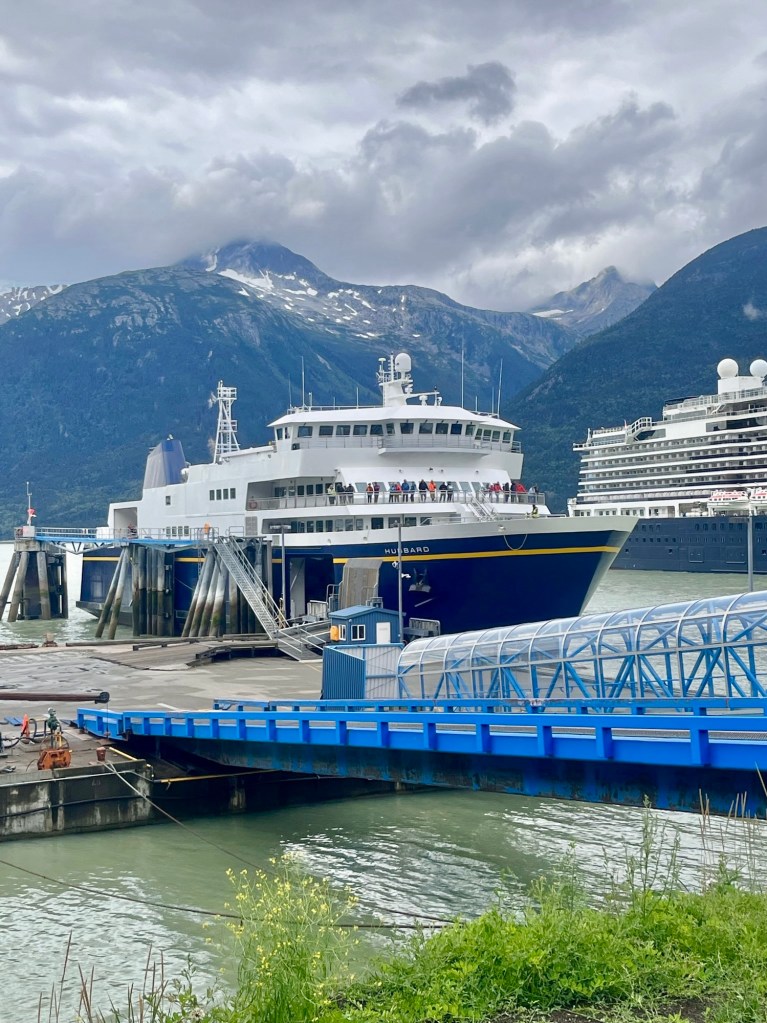
- By ferry: Since we were taking a road trip through Alaska, we took the ferry from Skagway, Alaska and drove our car onto the ferry (first time taking a car on a ferry for me). You can read more about that here.
- By flight: Outside of Anchorage and Fairbanks, Juneau is really the only other Alaskan city that is connected to the lower-48 by relatively frequent flights. For Juneau, nearly all flights will connect through Seattle or Anchorage, and flights are flown by Delta and Alaska Airlines. There are also flights to Juneau from smaller regional airlines from other smaller Alaskan towns, but we’re guessing that most people are flying from larger airports like Seattle.
What’s the weather like?
Bring your rain jacket and boots because Alaska is a rainy place. It rained both days we were in Juneau. This wasn’t a surprise since Juneau is one of the rainiest cities in all of Alaska. When I think about a rainy place, Seattle first comes to mind, but Seattle only rains around 37 inches a year, where Juneau gets about 62 inches!
The climate is pretty temperate, and summer temperatures (from June to August) usually range from 60 to 75 degrees F. Which is perfect for dressing in a bunch of layers!
Mendenhall Glacier
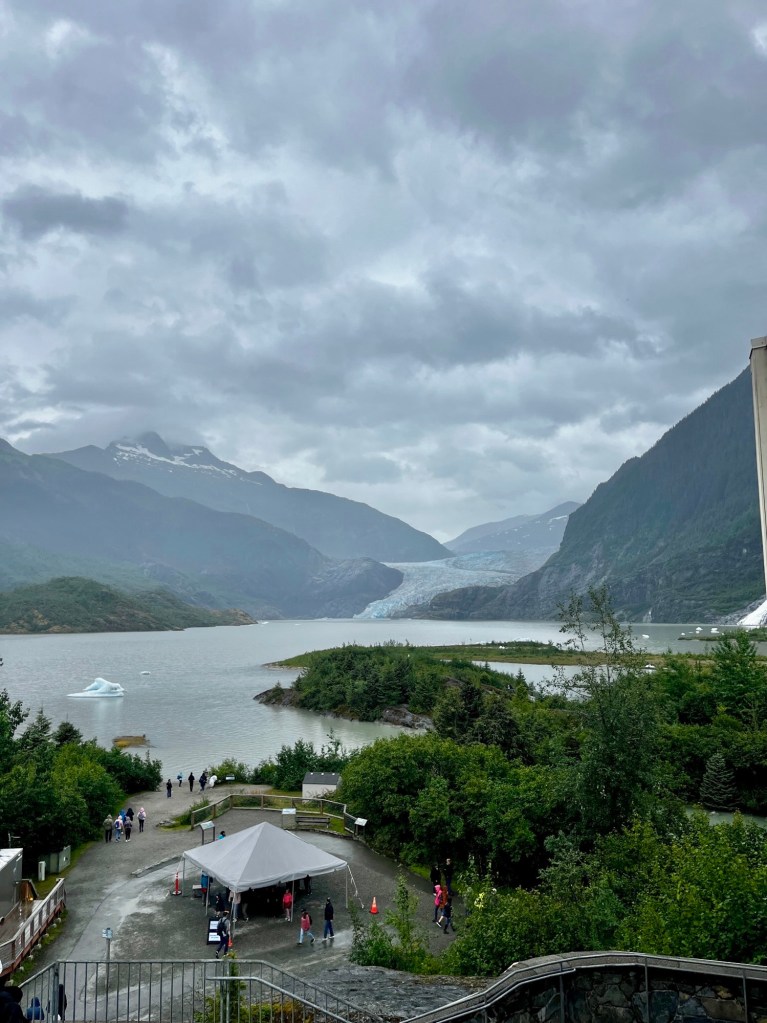
Located within Tongass National Forest, Mendenhall Glacier is an absolute must-see when visiting Juneau. The glacier is 13 miles long and is located just 12 miles from downtown Juneau. One reason that the glacier is so popular is its accessibility, as it is an easy way for tourists (especially cruise ship tourists) to see a glacier without going too far from the ship, having to hike, or going on a flightseeing tour.
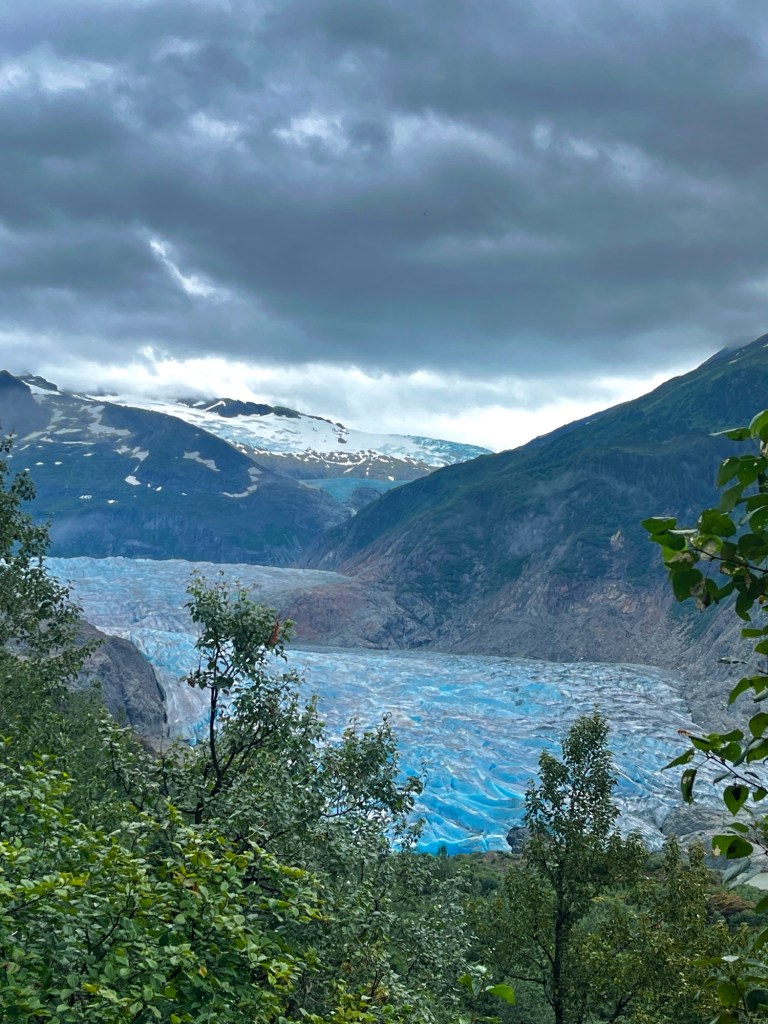
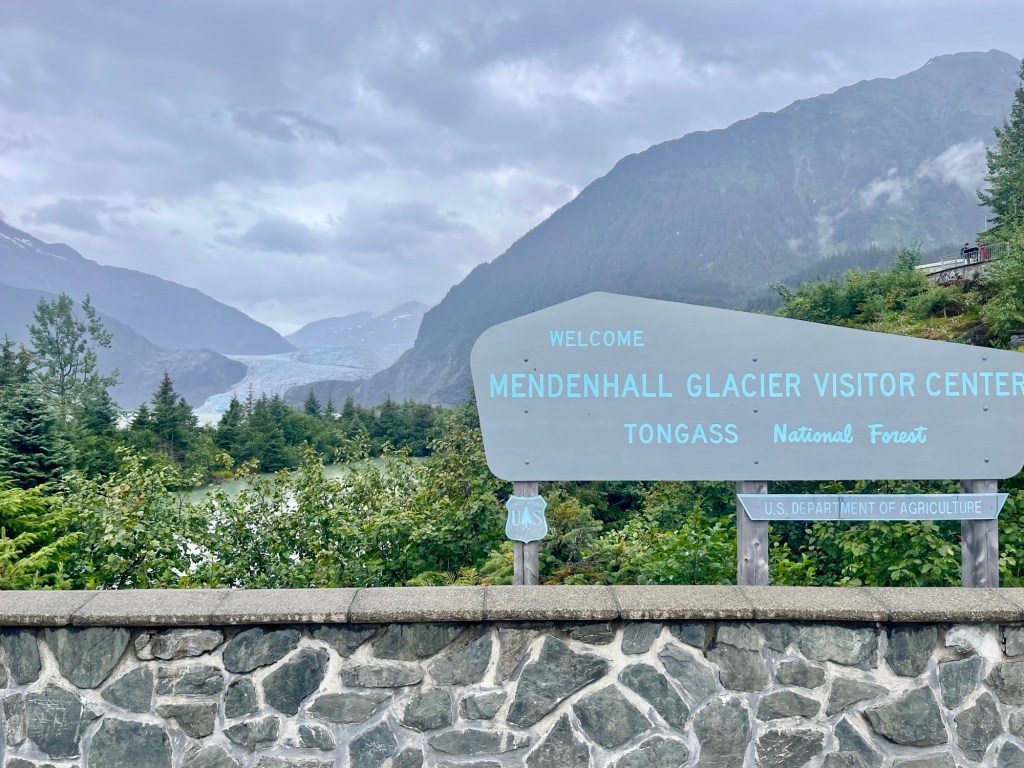
The Visitor Center at the glacier is also top-notch; definitely recommend checking it out for a bit if you have the time. You can learn a lot more about the history of the glacier itself, as well as the plants and animals that are in the area. Glaciers are something that really interest us, so it’s always fun to learn about how glaciers form or any glacier facts in general, and the visitor center does a great job of explaining that to a non-scientist! There are also some great views of Mendenhall, as well as Mendenhall Lake that the glacier flows into as well.
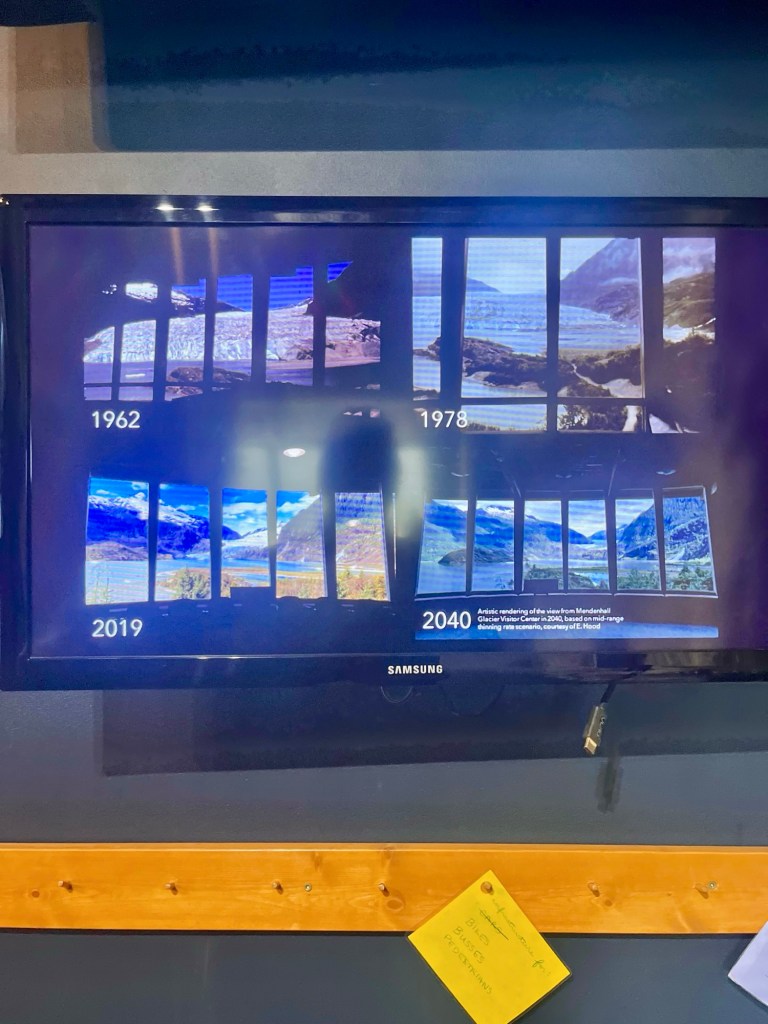
Understandably, there is a very large focus at the visitor center and trails surrounding the impact of climate change on the glacier. The retreat of the glacier has been accelerating in recent years, and over 2 miles of the glacier have disappeared since the late 1700s. The lake at the toe of the glacier has grown as a result, the ice caves around the glacier have become more and more unstable, and there are worries in town on the tourism impact to the town if the glacier recedes and recedes further. It is definitely striking as you walk through the trails and see markers throughout about the previous maximum of the glacier. It reminded us of the impact shown at Glacier National Park in Montana—of various glaciers in the park receding throughout photos over time at many of the park’s visitor centers.
Nugget Falls
For those who have a little more time, the Nugget Falls trail is another great and easy one to add to your time at Mendenhall Glacier.
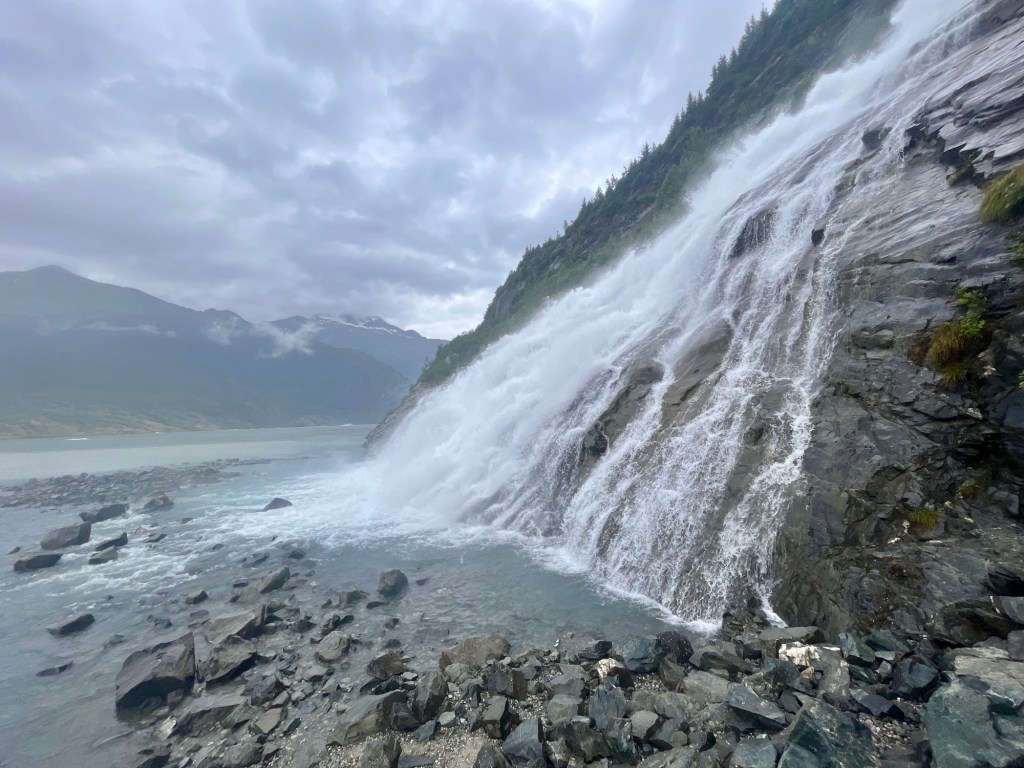
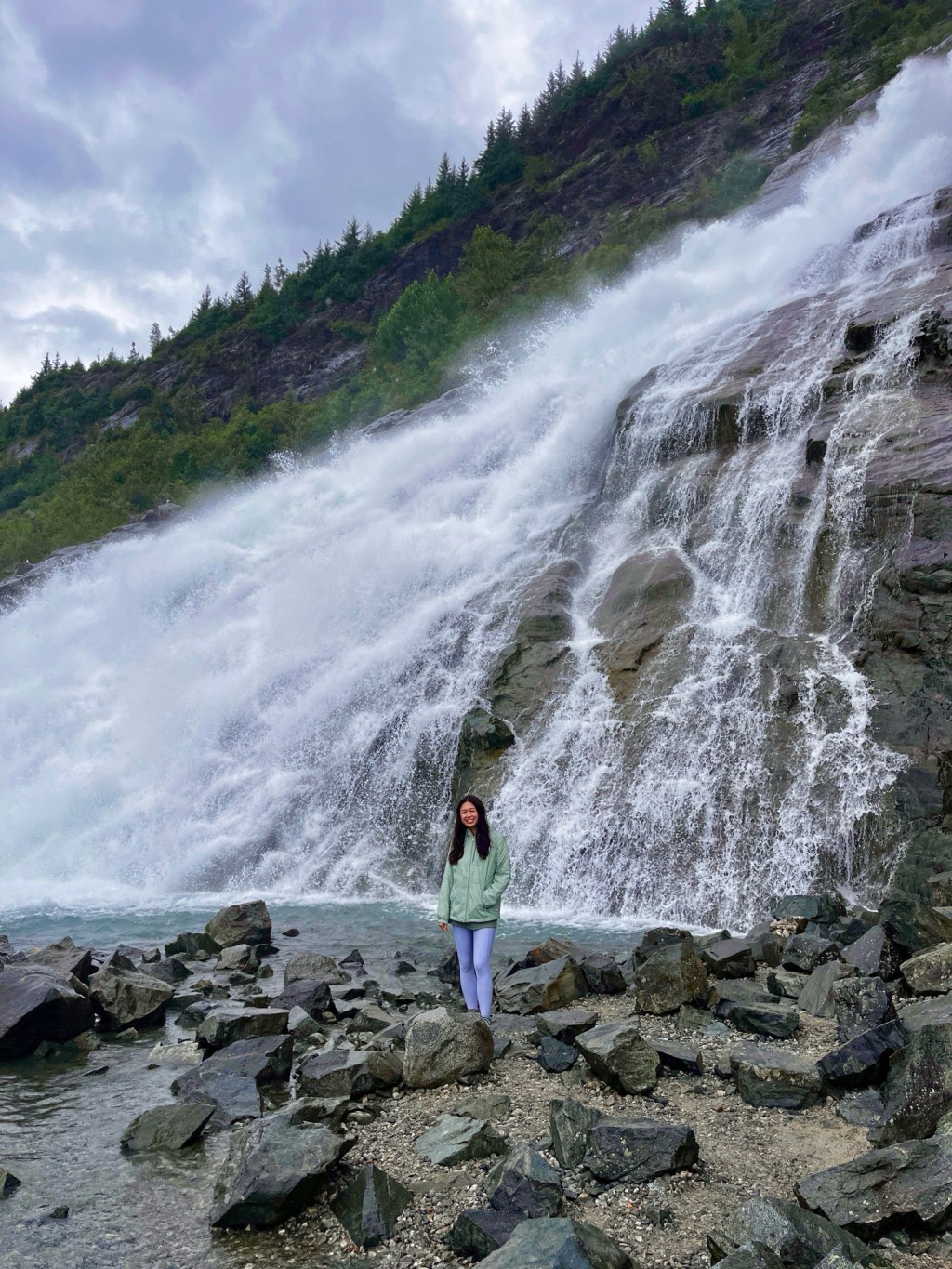
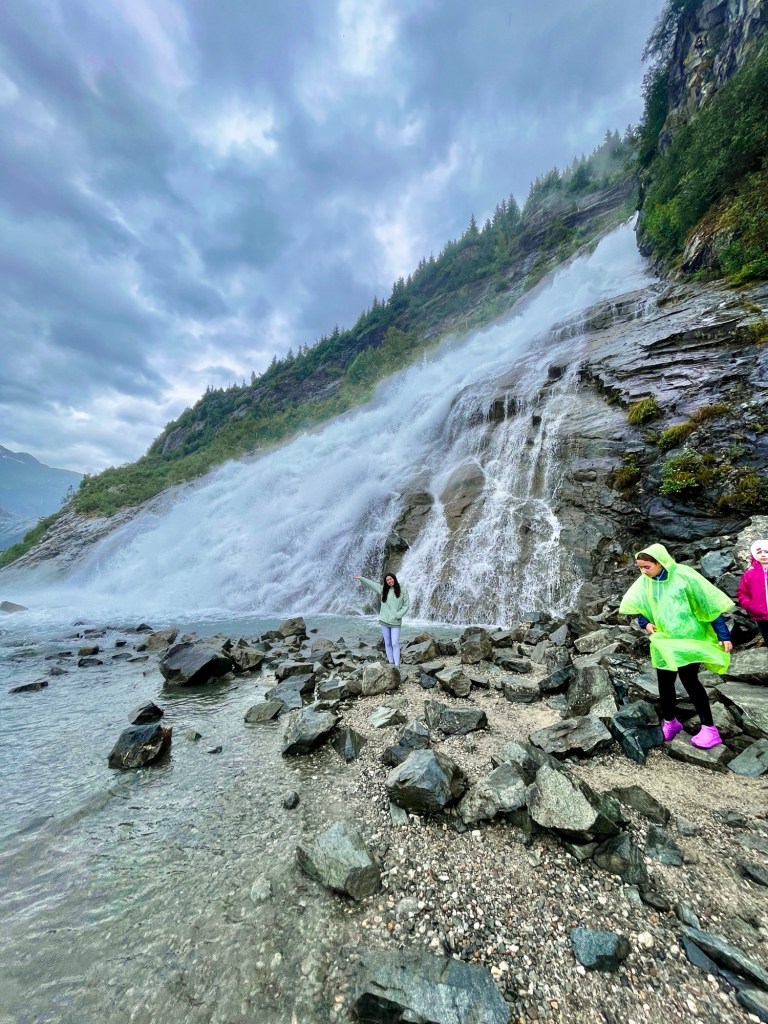
Nugget Falls is a 377-foot waterfall located near the base of Mendenhall Glacier and ended up being one of those unexpectedly beautiful Alaskan landscapes. We just were a bit surprised at how amazing these falls were as the trail to Nugget Falls is relatively short, at 2 miles round trip and around 100 feet elevation gain. It’s possible that we were there on a more “high flow” time of day/year for the waterfall, but either way, I’m sure that the hike to the falls will be more than worth it any time of year that it is accessible.
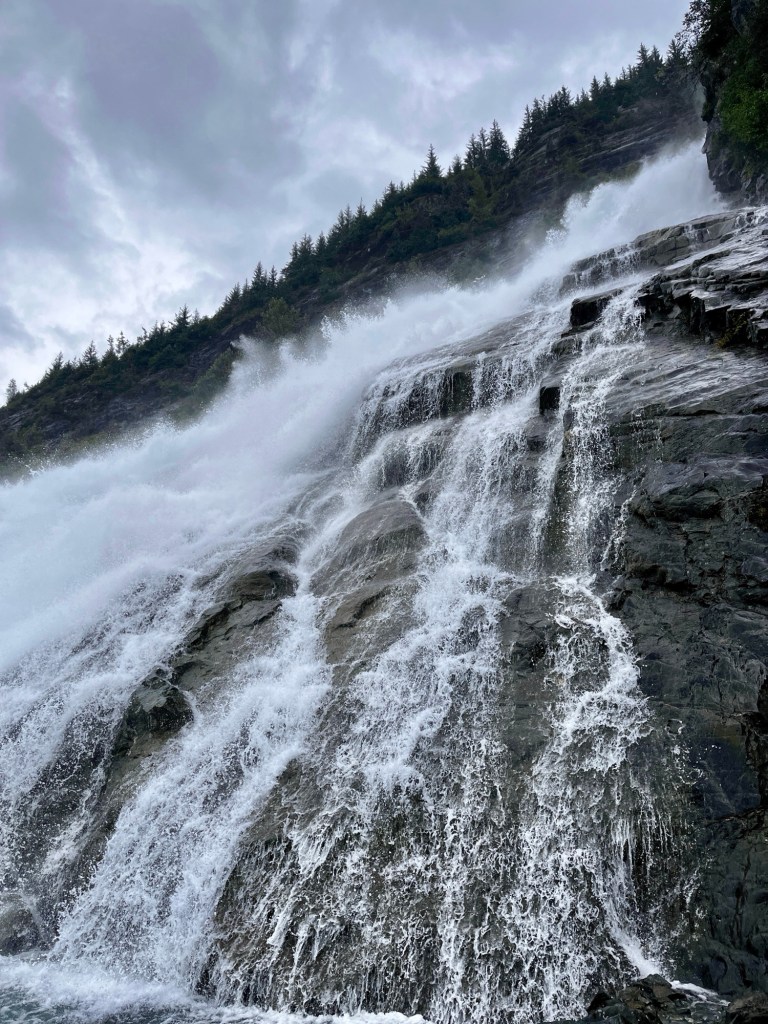
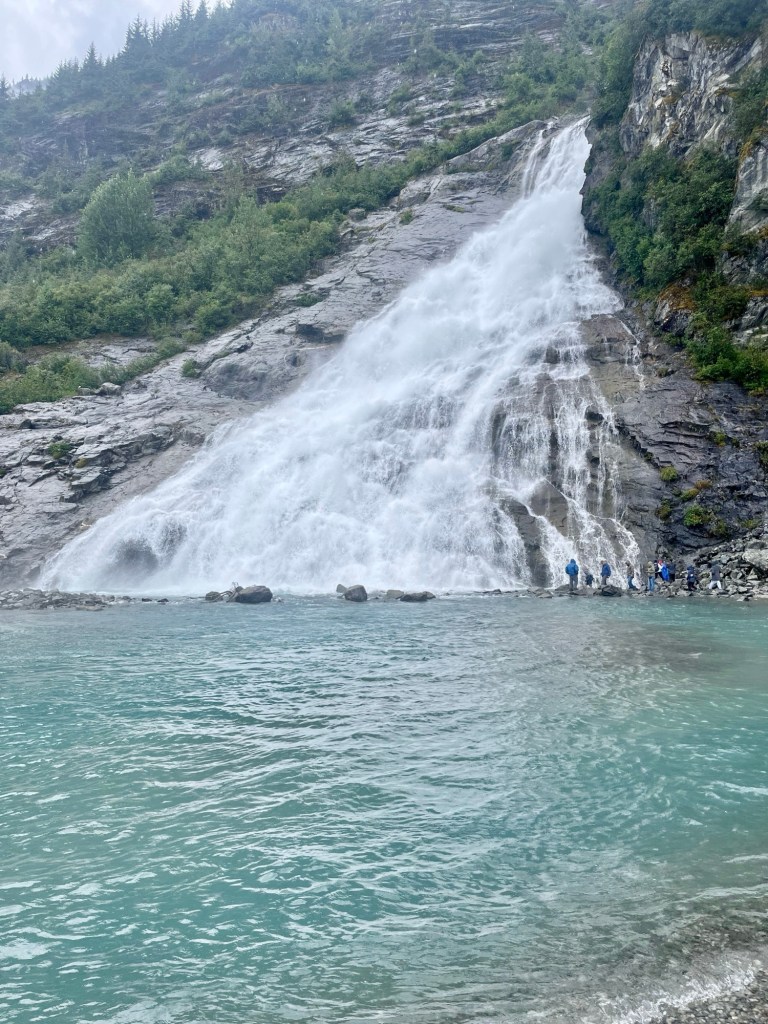
The waterfall flows into Mendenhall Lake, which is perfect for seeing the glacier in the background of your photos during your approach to the falls and at the falls! Definitely prepared for your clothes to get wet!
West Glacier Trail
Here’s where you can get a lot closer to Mendenhall Glacier! As a less accessible trail, the West Glacier Trail is unique among the ones mentioned here as it does not branch out from the Visitor Center itself or even within the Visitor Center “complex” near the toe of the glacier.
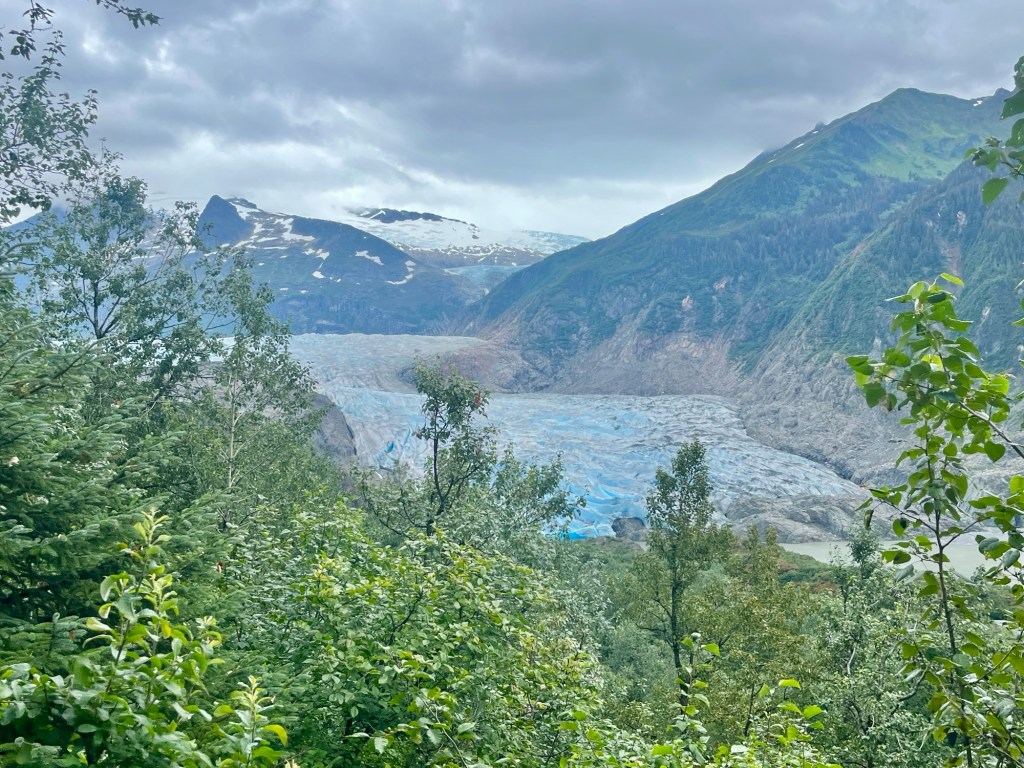
The West Glacier Trail begins at the Mendenhall Campground, around a 4 mile (10 minute) drive to the west of the Mendenhall Visitor Center. As a result, the West Glacier Trail is much less crowded than the East Glacier Trail or trails departing from Visitor Center, due to the fact that cruise ship shuttle buses and other modes of transportation/tours are less likely to head to this area. The primary visitors to the trail are those staying at the campground with their own vehicle, hikers with their own vehicle, or those on tours specifically for the west side of the glacier.
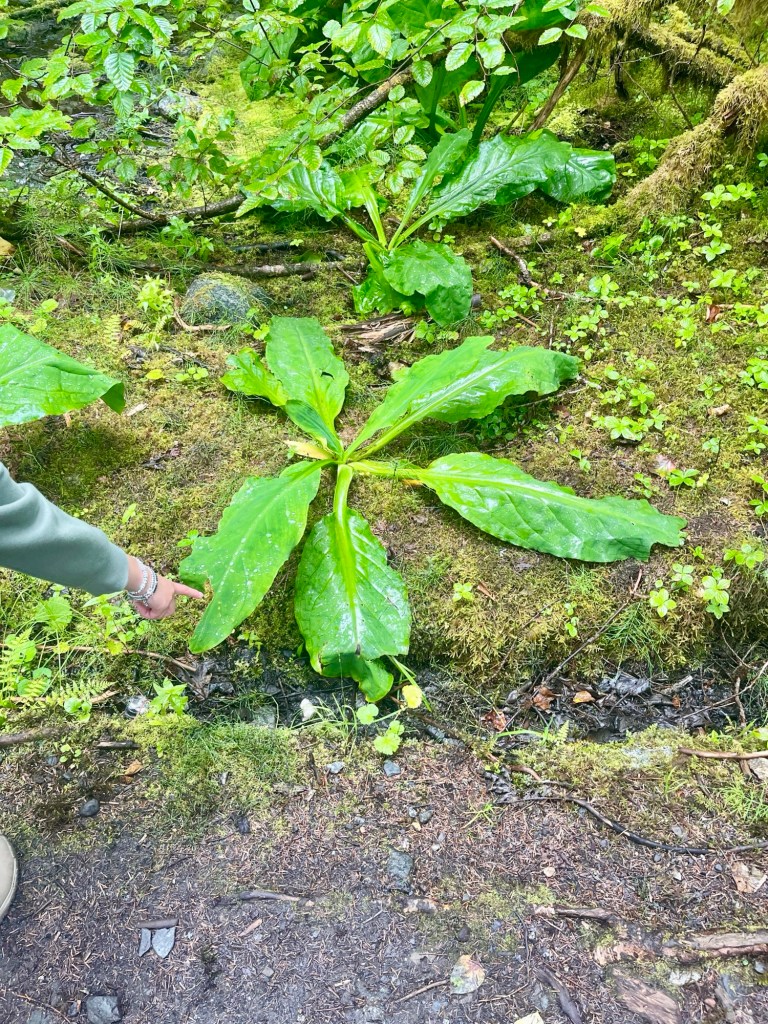
This trail has many different options for how close to the glacier you want to go to. Therefore, these possibilities also cause a difference in length of your hike, from around 4 miles (700 feet elevation gain) for the primary overlook of the glacier from the west side, to over 8 miles (1,300 feet elevation gain) if you go far as possible—even up to touching the glacier itself!! We are not experts on glacier safety and hiking, and we also unfortunately did not have the time to go past the primary overlook as mentioned above, but there is SO MUCH to do here.
Depending on weather and other conditions, the trail gets more rugged after the primary lookout and with some more intense hiking, you can get very close to the glacier itself. I can’t promise that it’ll be easy or that it’s always be accessible, but if you’re an adventurous person, this is probably your hike to do around Mendenhall.
Other Mendenhall Glacier Trails
The photo below shows a map from the US Forest Service with nearly all of the Mendenhall Glacier area trails, except the West Glacier Trail. This Alltrails link includes the various trails as well and includes the West Glacier Trail!
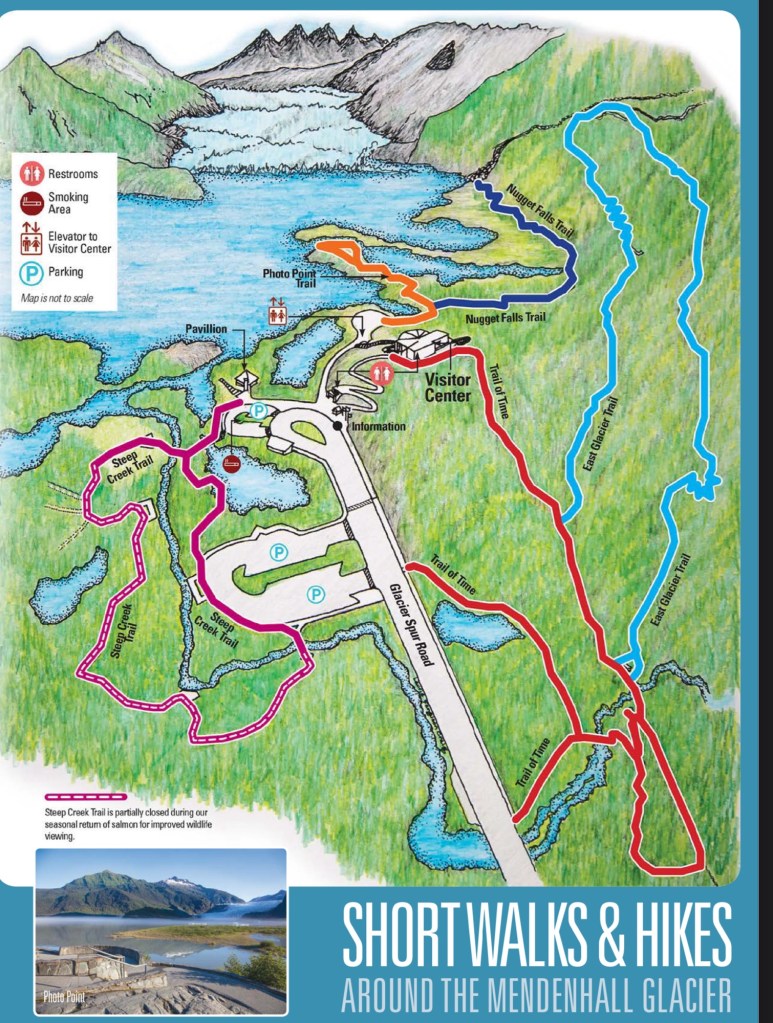
Once you’re in the park and leave the Visitor Center to hike, it’s super clear which direction to go for each of the trails, as they are very well marked!
Also, remember to always be aware of wildlife in the area while hiking. Keep an eye out for bald eagles, beavers, black bears, and even porcupines. Per usual, it is always important to keep bears in mind—and to make sure to give bears more than enough space, especially during salmon spawning season which happens in the park in late summer. A common place to see bears in the park during this time is in Steep Creek.
Easy Trails
For those looking for an accessible trail with nearly no elevation gain or a quick trail to get closer to the glacier, the Photo Point Trail (0.6 miles in length, 10 feet elevation gain) is great, as it leaves from the visitor center, and provides exactly what the trail names says: a great point to take photos from!
The Trail of Time (1.5 miles in length, 10 feet elevation gain) is another option for a trail with relatively little elevation gain. However, during this trail, you head away from the glacier, versus towards it, as this trail primarily walks through land that was previously part of the glacier’s typical flow range, now growing with a young forest. We have not hiked this trail before, and I’m sure it is beautiful, but for those who are at the park to get as many views of the glacier as possible, this may not be the best trail.
Moderate/Hard Trails
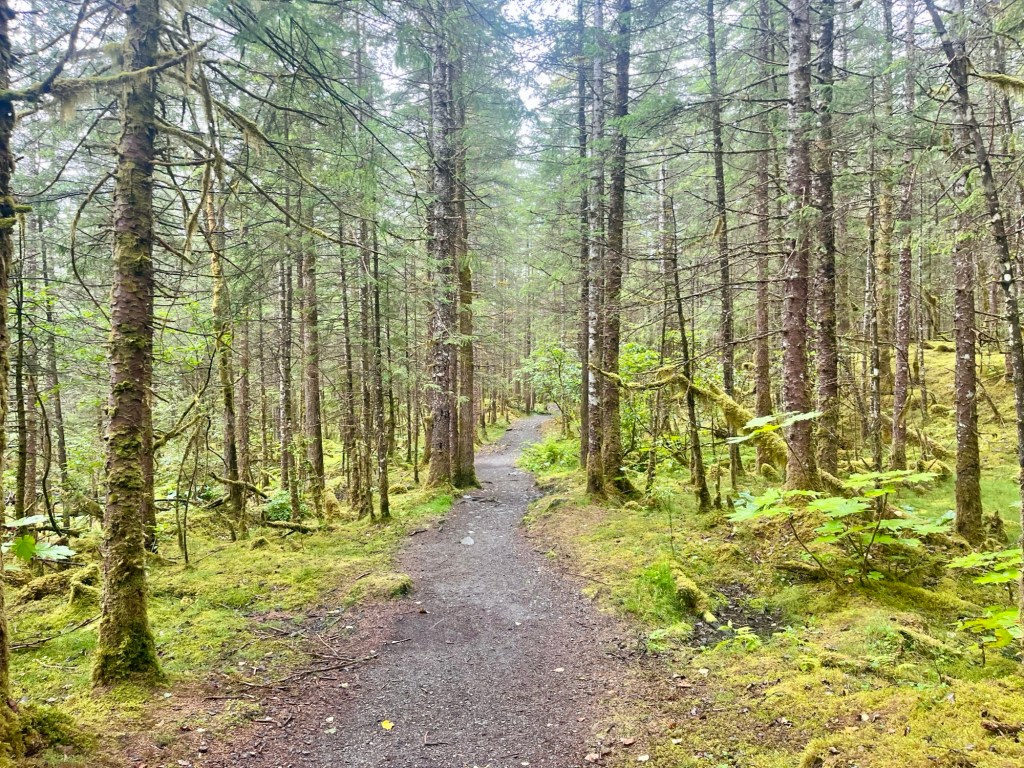
Unlike West Glacier Trail, the East Glacier Trail is a more moderate trail that begins at the Visitor Center. It is a 3.5 mile loop, with around 750 feet elevation gain, that allows you to get much higher than you would at any of the trails above and the Visitor Center, for some great views of Mendenhall Lake and the glacier itself. The trail goes through a temperate rainforest with beautiful mossy old-growth trees, and there are opportunities to see wildlife as well.
This trail is certainly still well traveled, but also will probably be much less crowded than the shorter trails, especially Nugget Falls and Photo Point Trail. East Glacier also intersects with the Trail of Time for part of the loop, so you also have the opportunity to learn about the history of the glacier, climate change, and glacier recession.
Tracy’s King Crab Shack
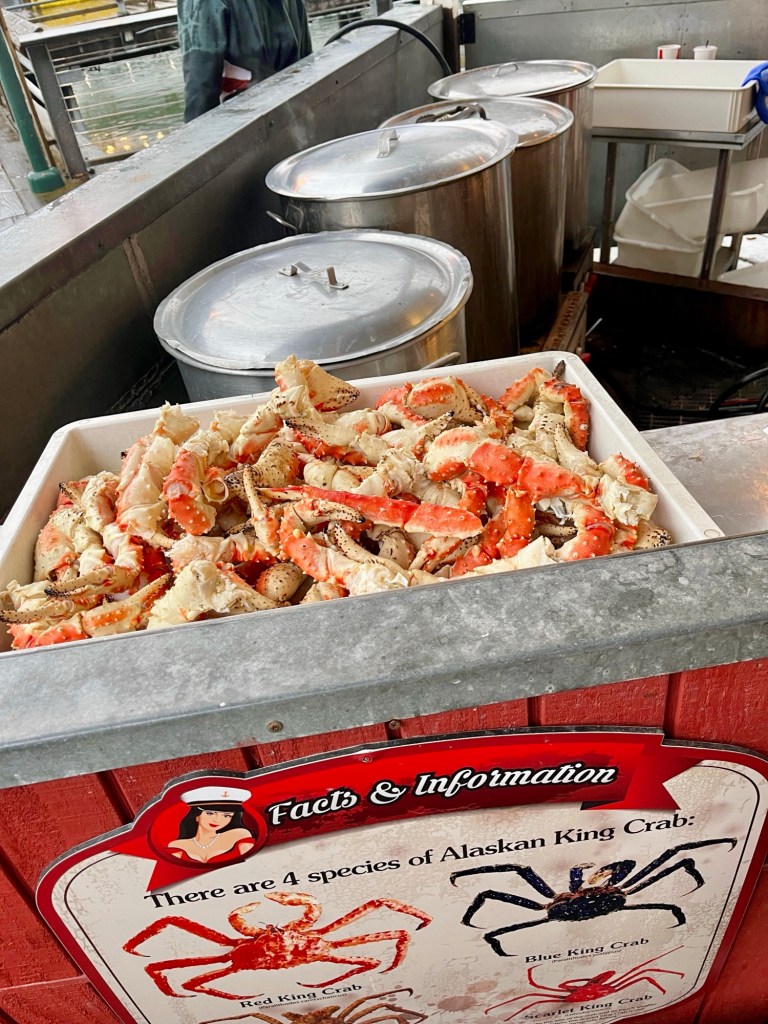
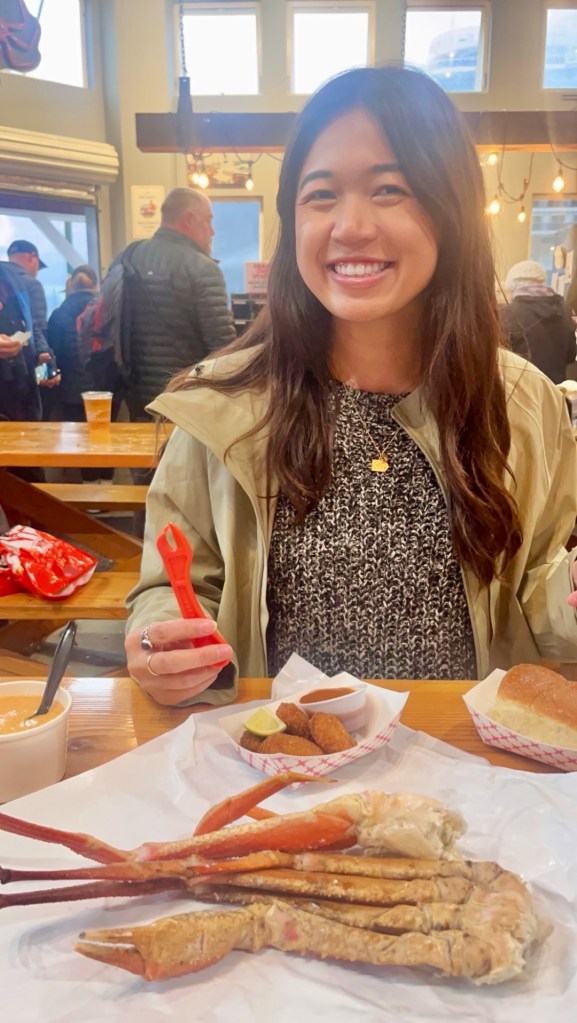
Time to get fresh crab legs and there’s no better place than Tracy’s King Crab Shack. You can see the giant vats of boiling water ready for cooking as they continuously bring in more fresh crab they’ve caught daily. Whether it’s by the bucket, basket, crab cakes, or crab chowder, we ended up coming back here a few times because it was just so good. My family loves getting king crab legs from Costco and I was surprised to find out they’re actually caught from Juneau!
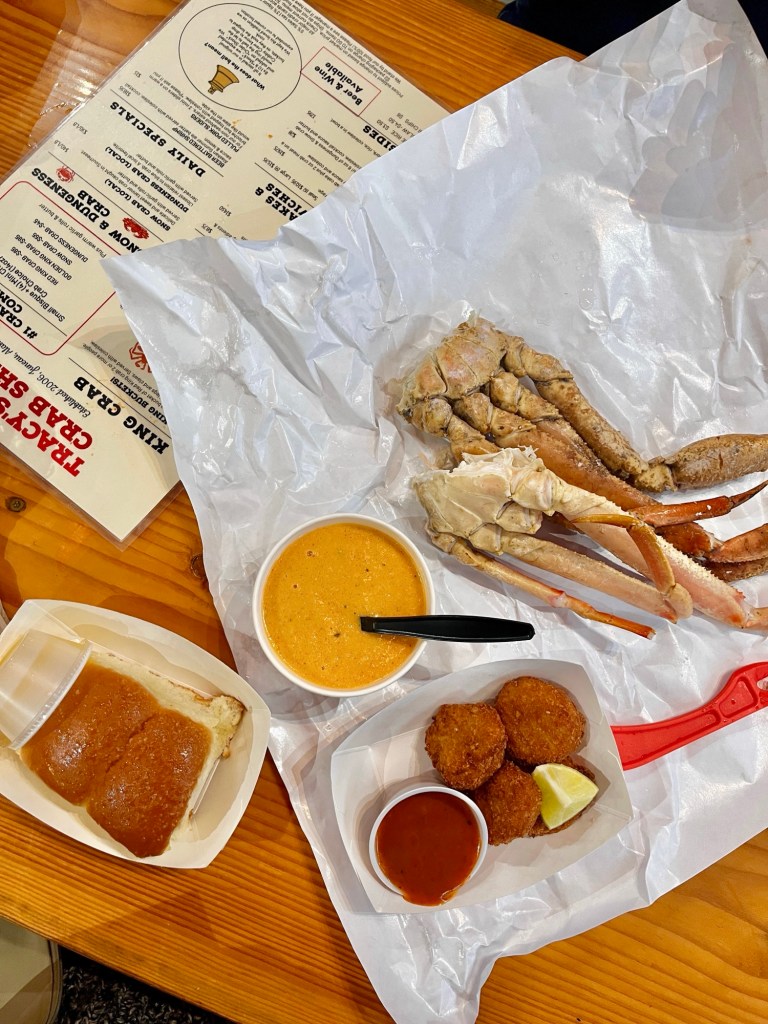
So how could you not cut out the middleman in Juneau (and all over Alaska if you can!) and get some fresh crab in the city at somewhere like Tracy’s Crab Shack. The shack has two locations: the main one at 432 S Franklin Street—right across from the Juneau Cruise Ship Terminal—and a second location about 10 minutes away at 300 Whittier Street. The two locations are only around a 15 minute walk from each other, and we went to both of them. If you’re on a time crunch, it may be better to go to the location at 300 Whittier Street (Tracy’s Crab Shack 2), as it’s further away from the cruise terminal so you might get your food faster. However, we were surprised that even the location near the cruise ship terminal served you relatively quickly, even with the crowds!
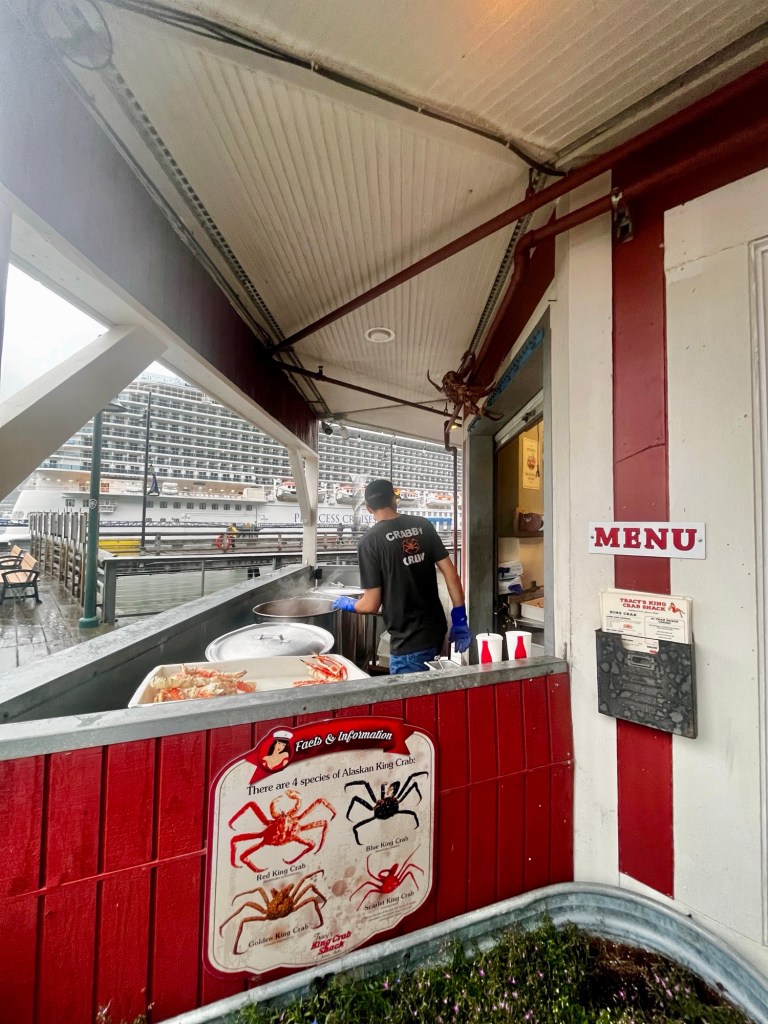
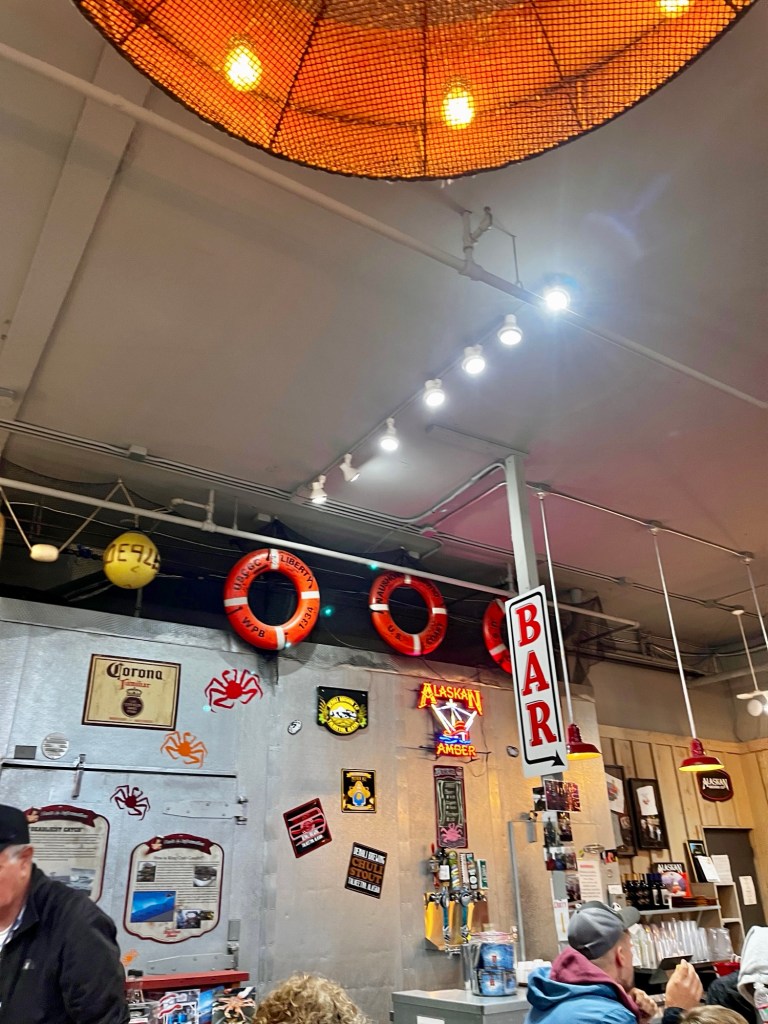
They don’t take reservations and is more of a “beer hall” type seating, so while there are no tables for individual groups, this makes it a great place to meet other travelers and locals you’re sharing a table with and creates an awesome lively atmosphere. However, try to go on off-times if you’re looking to get served super quick!
Red Dog Saloon
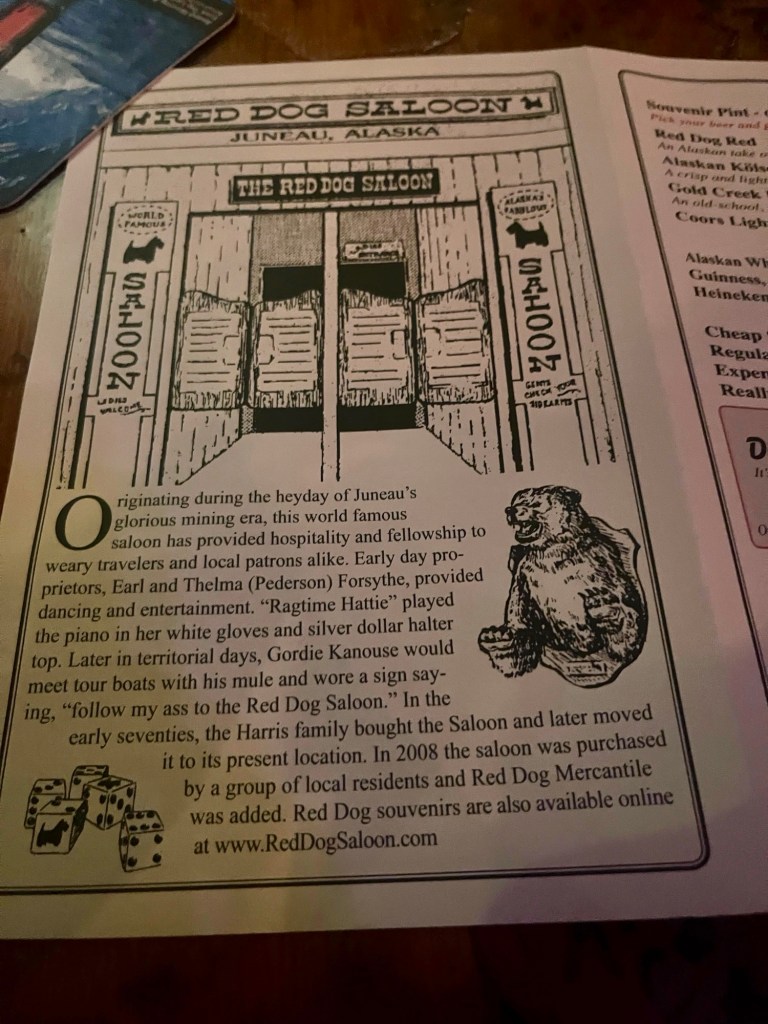
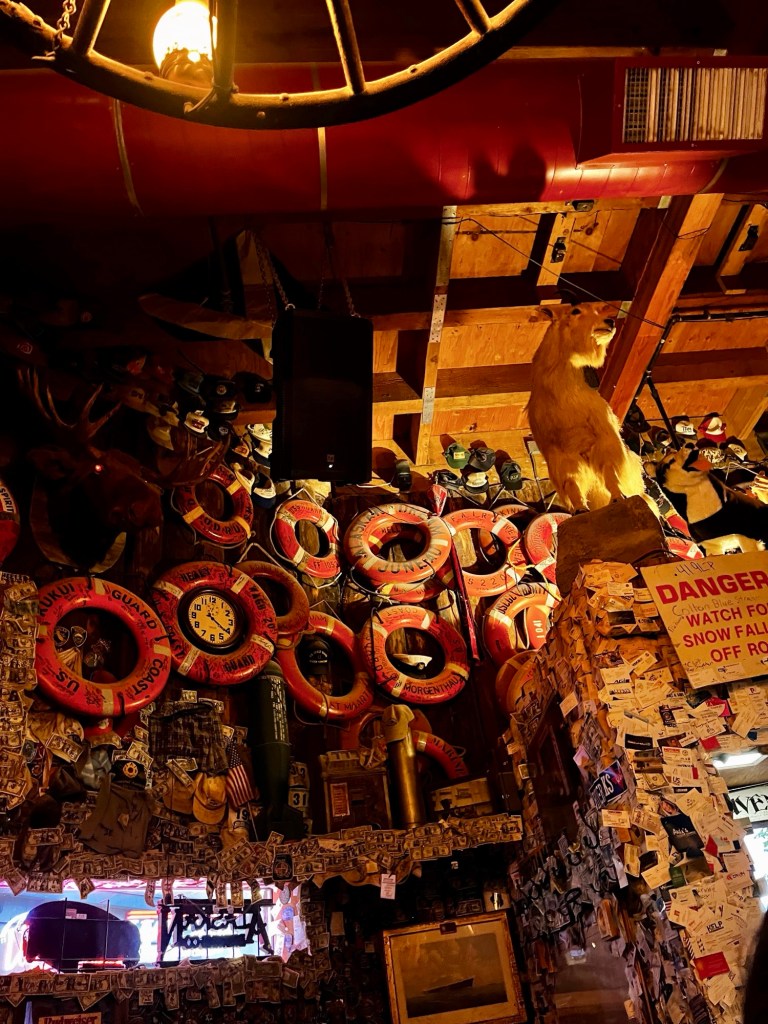
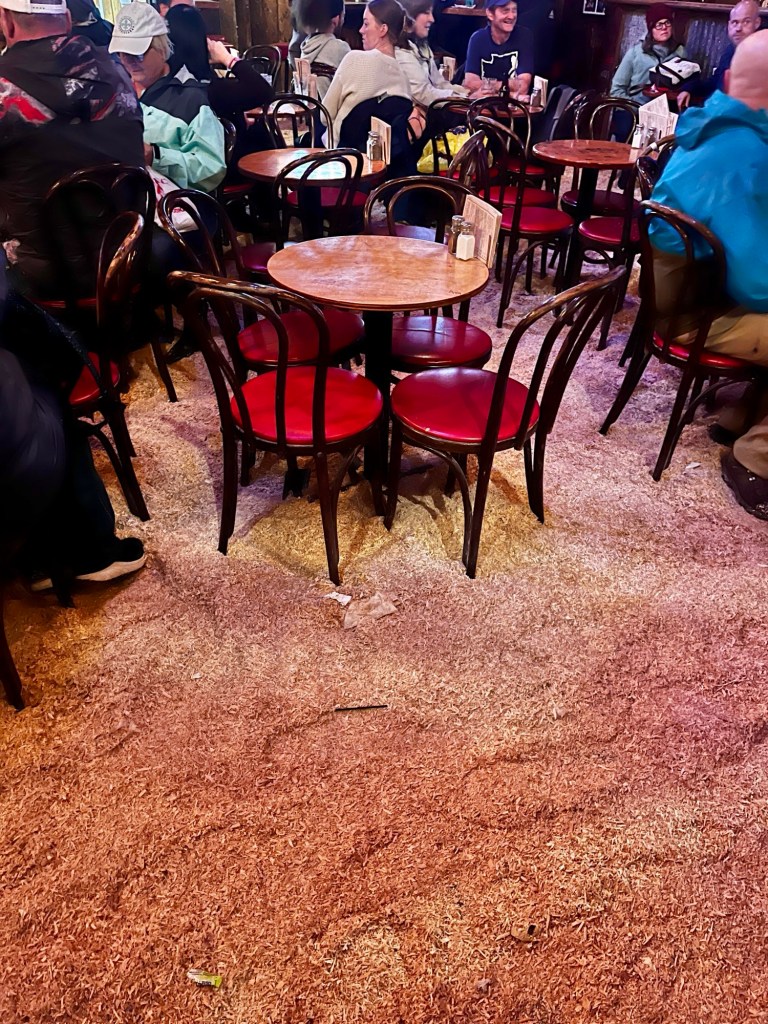
The Red Dog Saloon is a historic bar in downtown Juneau, Alaska, that was opened in the late 1800s, during the Klondike Gold Rush. Nowadays, the saloon has a very “wild west” type atmosphere, with sawdust-colored floors, mining relics, and animal heads all over the walls. It certainly is a touristy place, but it is one of those touristy places that actually feels worth it to check out. The ambiance and live music definitely lead it to be the most lively bar you can find in Juneau.
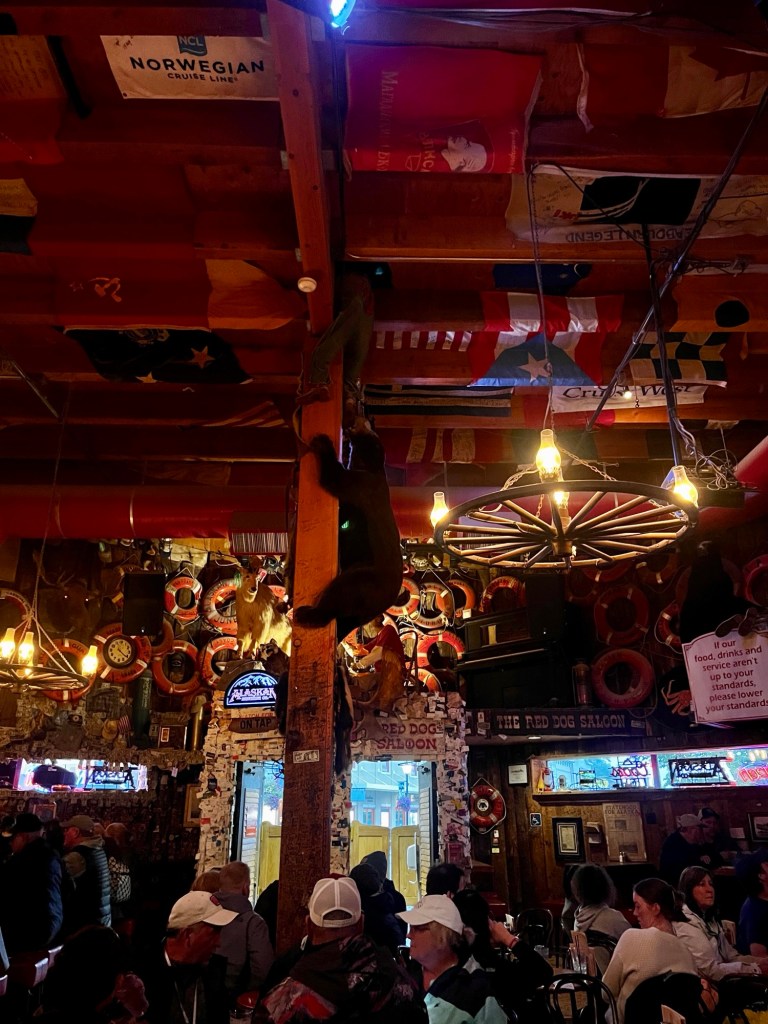
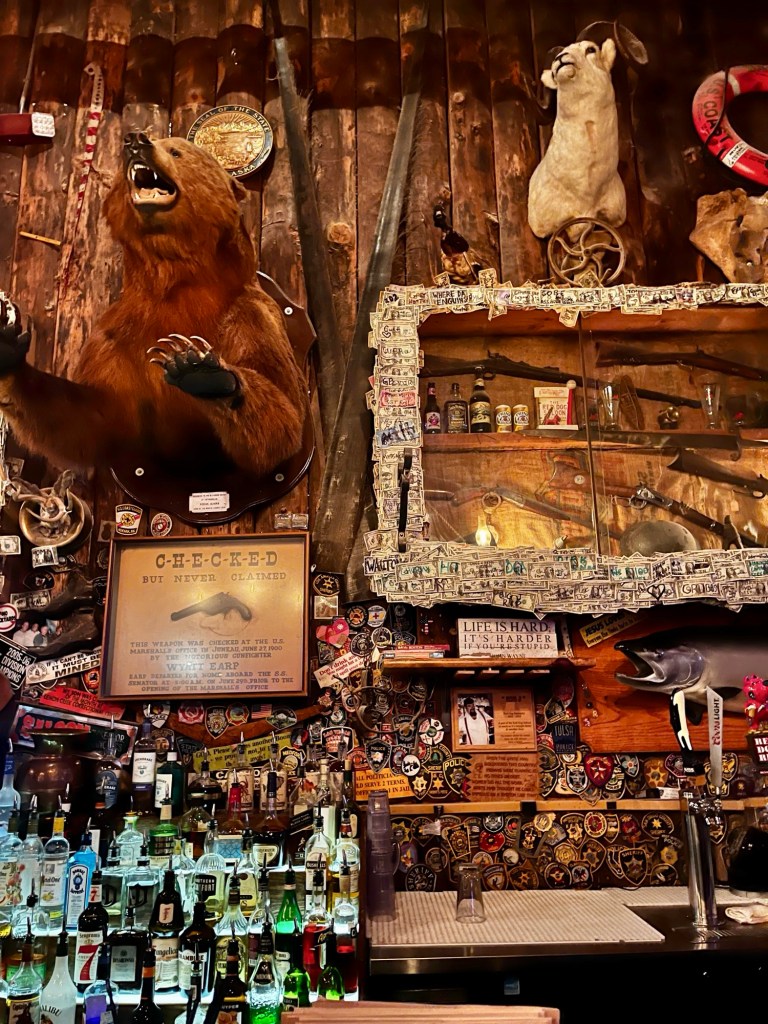
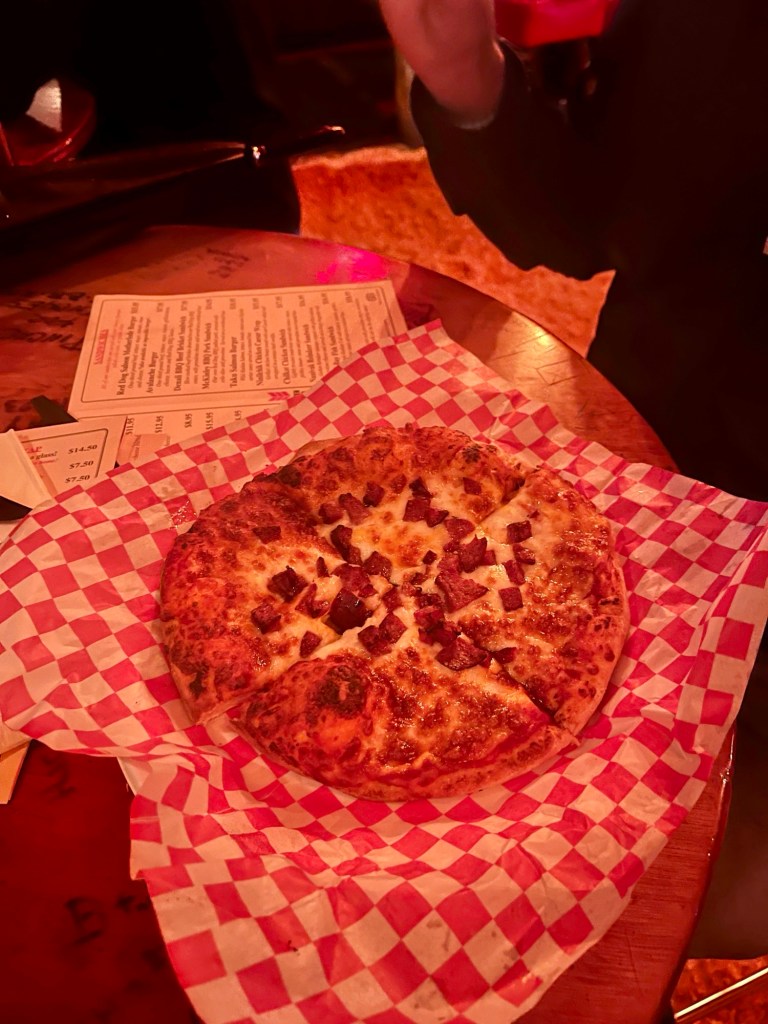
The saloon also has a signature drink, the Duck Fart (a shot with Kahlua, Baileys Irish Cream, and Crown Royal whiskey). There are also some fun Alaska-themed foods to try, and it is the first place that we tried reindeer (sausage on a pizza), which was surprisingly good (sorry Rudolph :().
We definitely recommend checking out the Red Dog Saloon if you have the time, it can be a bit crowded in the summer but not in a bad way—the live music, crowd, great atmosphere, food, and beer all together is worth at least a drink or two!
Whale Watching Tours
Why whale watch in Juneau?
As one of the best in the United States and probably the best in Alaska, Juneau is an incredible place for whale watching tours! For those who are visiting Juneau on a cruise ship, this certainly will be one of the excursions offered as an option, but is easily accessible as a tour for those who fly, or take in the ferry to Juneau as well. It’s also helpful for those who do not have a rental or personal car with them in Juneau, because the majority of tours offer transportation to the dock for the whale watching tour.
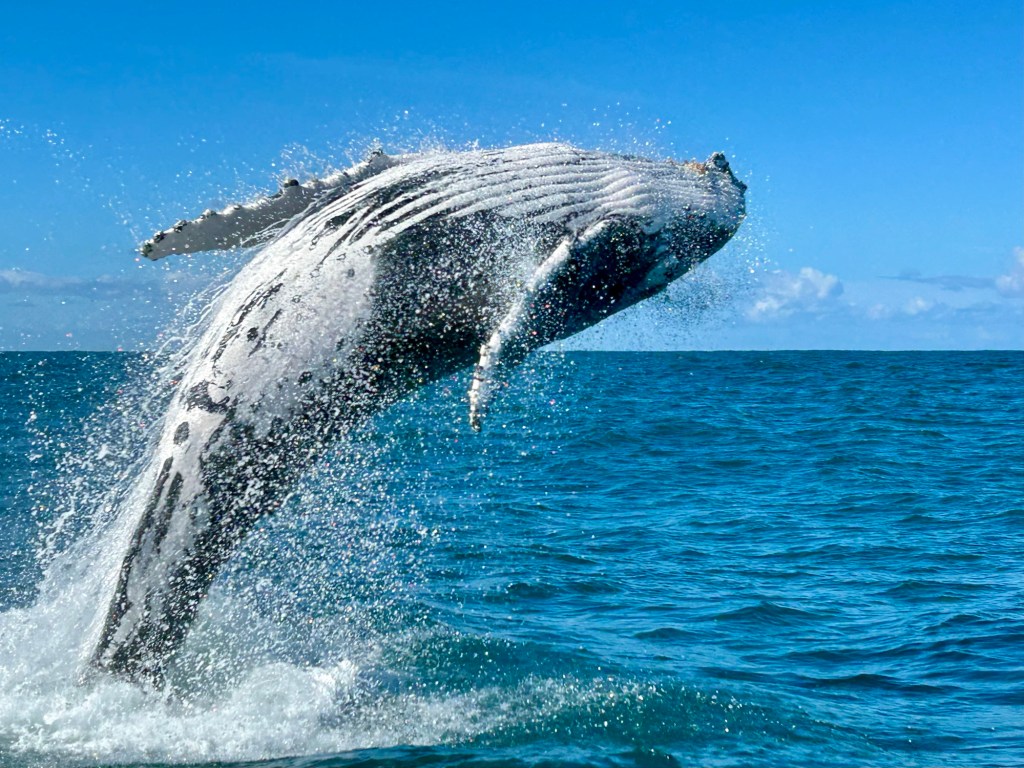
Another amazing thing is that the peak time to see the whales (particularly humpbacks) in Juneau is in May-September! This perfectly aligns with the summer season where people will be mostly likely visiting the city anyway. Humpback whales of the Pacific migrate to Juneau after wintering in Hawaii, so the ocean around Juneau is a great place for these whales to feed during the summer.
What tour company to choose?
There are many outfitters offering tours in the city between May through September that you can learn more about here and here. There is a large range of outfitters, with many offering a similar “standard” tour—that goes for around 3 hours, usually around 2 hours on the water itself, and is led by a naturalist guide who can help you understand whale behavior, other natural aspects of the ocean, and the land surrounding Juneau. Even though this is the “standard” tour, that isn’t a bad thing! You likely will learn about (and see) a ton of amazing humpback whale behaviors, such as spy-hopping, breaching, and even bubble net feeding!
Where do the tours go? Will the water be choppy?
Whale watching in Juneau typically takes place in the calm waters of Auke Bay and around Stephens Passage. Some specialized tours or those longer than the typical “standard” length will go to Lynn Canal, or the Chatham Strait, which are more remote and also offer great wildlife opportunities. However, it’s likely that the specific place you go to on your tour will depend on recent wildlife sightings and the patterns of local whales, so you have the best chance that you can of seeing them!
Why are humpbacks special?
Humpback whales are great for whale watching as they are often very approachable, frequently display cool behaviors, and they’re known to be curious, so there’s a higher chance they will be interested in checking out tourist boats and coming closer! So while the standard tour is likely the most price-conscious and “normal” route, there are also outfitters that offer more personalized tours. These are longer than the typical length, or even private tours for those interested. That is why it’s helpful to go through each of the options on the outfitter’s websites, as well as any options provided by the cruise ship, to see what’s the best fit for you!
What about other animals?
It’s makes it all the more exciting because not only can you see humpback whales, you can also see other animals, such as sea lions, porpoises, seals, and bald eagles. Although the focus may be on humpbacks, the guide will be sure to point out any other animals that are spotted.
One of our favorite animals in the world is the Orca. There are two types of orcas found in the region: resident orcas, which mainly eat fish like salmon, and transient orcas, which hunt marine mammals. However compared to the humpbacks, which may typically feed in the same areas mentioned above (such as Stephen’s Passage), Orcas move and appear more sporadically.
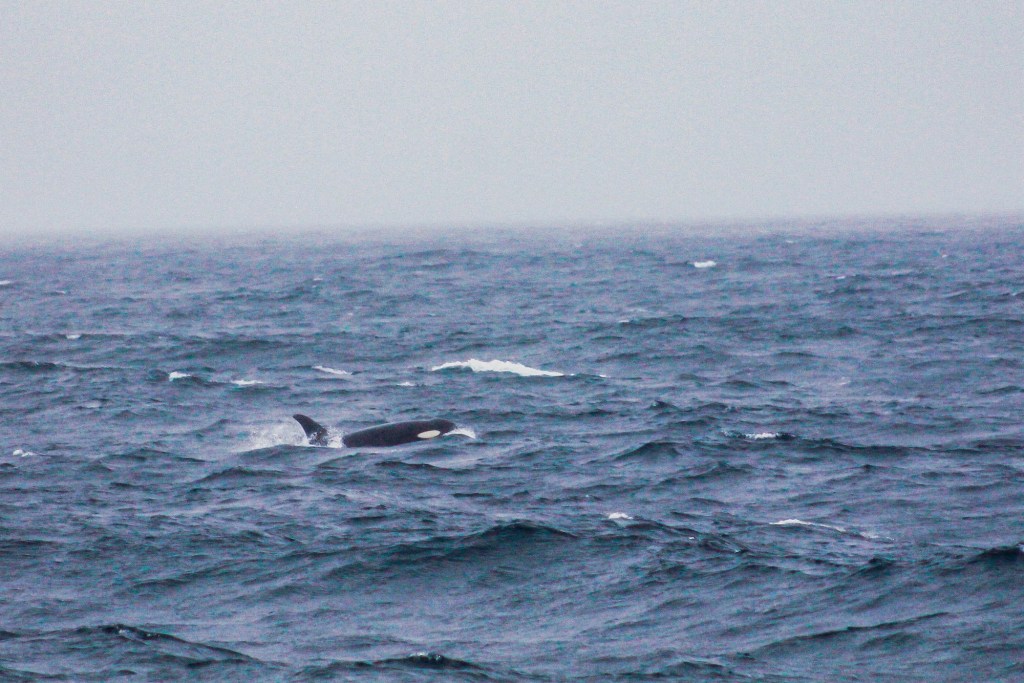
I am not sure if there is anywhere in the world where you are “guaranteed” to see Orcas – but all things considered Alaska is one of the most likely places where you will see them. Cross your fingers that you will get to see some of these amazing animals.
What happens if I don’t see whales?
Amazingly, it is very unlikely this will happen between May – September! However if it does, almost all outfitters offer a “whale sighting guarantee” so that if you do not see any whales on your tour, you will have a full refund, or the ability to rebook to another available date if that is possible with your schedule.
Should I book in advance?
YES! it is very common to have these tours sell-out in the summer! Don’t miss the amazing opportunity and make sure to book your tour as early as you can!
Tracy Arm Fjord
The primary reason people go on the tours to the Tracy Arm Fjord is to see the Sawyer Glaciers, which consists of two specific “sections” called the North Sawyer and South Sawyer Glaciers. The North Sawyer glacier is the section most commonly visited on tours, as the South Sawyer Glacier is not as accessible and more weather-dependent.
The Sawyer Glaciers are both active tidewater glaciers and are both famous for commonly calving large icebergs into the fjord. Seeing this is an unbelievable sight, from the thunderous sound, increased chance of seeing the blue underside of the glacier, and to just the sheer size of the glacier and the parts that are calved off.
On the tour, it’s possible to get as close as half a mile to the base of the glacier, which may not sound super close, but when you consider all of the floating icebergs in the water or a chance the glacier may calve off a piece of ice larger than the boat you’re on at any second, it’s understandable why you don’t want to get too close!
On the edges of the glacier rising up are sheer granite cliffs that raise thousands of feet above water level, as well as numerous waterfalls you may spot amongst the cliffs. Furthermore, you are in Alaska, so you have the chance of seeing tons of different wildlife. There’s a chance of seeing humpback or orca whales on your trip to the fjord, and while at the fjord itself, it’s common to see harbor seals resting on icebergs, bald eagles in the sky, and mountain goats on the cliffs surrounding the glaciers.
Luckily, the best place to visit the Fjord is also during the summer! Warmer weather helps with high wildlife activity, and most importantly, is the most active time of glacier calving. You are certainly not guaranteed to see gigantic calving, but it’s very likely, and is very exciting to just stare at the beautiful glacier and watch to see what happens! If you’re looking to take photos or videos of the calving, be ready as it goes from calm to crazy within just a few seconds when it happens. Many times, you won’t even realize the glacier has fallen off until you hear the boom!
While the Sawyers Glaciers are not the only tidewater glaciers in Alaska, they’re certainly a relatively accessible one that would be great for someone who may not be visiting one in Prince William Sound, Seward, or Glacier Bay. They’re definitely worth considering if you are interested in the potential wildlife sightings, as well as the absolutely incredible scenery and chances of large calving events. Check out one of the outfitters here!
Endicott Arm
This will be a short one! I know I gave a lot of detail above on the Tracy Arm Fjord, the Endicott Arm is another fjord within the Tracy Arm-Fords Terror Wilderness area, and is actually commonly visited as the “rain check” backup location for tours to the Tracy Arm Fjord. Funnily enough, the Tracy Arm Fjord is the “rain check” backup location for tours to the Endicott Arm.
Within the Endicott Arm is Dawes Glacier, which similar to the Sawyer Glaciers, is known for its spectacular calving events, scenery surrounding the glacier (and on the ride to it), as well as wildlife!
So while your tour to Tracy Arm Fjord or to the Endicott Arm may result in your appearing at the other area, no matter what, I think you will have an amazing time if you are looking to see your first (or more!) tidewater glacier.
One more thing to mention though is that it appears to be more common in recent years for tours to primarily focus on the Endicott Arm, especially on larger ships, as there has been larger amounts of ice at the Tracy Arms Fjord. Probably good to keep this in mind, but I am certain that either option would be great.
Mount Robert’s Tramway (and Hiking Trails!)
Compared to many of the other activities mentioned in this post (and commonly done from Juneau!), The Mount Roberts Tramway is located much more central to the town itself. However, just because it is located in the downtown area does not mean that you won’t be immersing yourself in some beautiful Alaska nature.
The tram rises 1,800 feet from the downtown waterfront up to Mount Roberts. The ride takes about six-minutes, and will give you some great views of Juneau itself, as well as nearby islands and the Juneau harbor. Another great thing about the pass for the tramway is that it offers unlimited rides on the tramway for that day. So you can go up and down as much as you want, which is great for the scenic aspect, as well as for the fact that you can visit the mountain in the morning, explore the town or go on a tour, and then return again later in the same day, no questions asked!
I also want to mention that it is common for people (especially locals) to climb up to the “end” of the tramway as part of a hike, whether for fun, to access other trails on the mountain, or to visit the facilities mentioned as part of the tramway. However, this is very steep (1,800 feet), but it is an option if you have the time or want to save the $55 for your round trip tram ticket. An Alltrails map that includes this rough path is here.
What to Do on Top (Besides Hiking)
After the ride, there is a large amount of activities on top of the mountain that many tourists would enjoy. There is a large focus of the tramway and “mountain house” above on supporting local Alaskans, as well as supporting Alaska’s indigenous people and cultures. There are cultural exhibits by the local Tlingit, Haida, and Tsimshian communities, with interpretive displays, artwork, and occasionally live performances showcasing traditional songs, dances, and storytelling. There are also typical souvenirs available, but focused more on local Alaskan craftsmanship. The Mount Roberts Tramway itself is owned and operated by Goldbelt, Inc., which is a Juneau-based Alaska Native corporation.
If you are looking to eat (or drink hehe) while enjoying the view at the top of the mountain, there are some options as well, including The Tr’Ale House, a craft beer bar that also serves ciders, wine, and offers more typical “bar” food. Nearby as well is the Timberline Restaurant, which has more of the “fancy” Alaskan food that you would see (king crab, halibut, reindeer) and classics you’d expect (steak, burgers, etc.).
There are also various tours offered by the tramway, including areas of focus such as local native history, the flora and fauna on top of the mountain, craft beer offered at the bar on top of the mountain, as well as other attractions in the city. All of these are combined with your tram ticket itself, and packaged in a tour offered by the tramway. Check out some of the tours here if you are interested!
Hiking Trails
Lastly, one of the most common reasons people visit the tramway and one of the most popular attractions are the various hiking trails on top! As I mentioned above, some people will access these trails by tram and some people will access them by hiking up from the city, which is almost 2,000 feet elevation gain just to get to the tramway! I would say for the majority of people, it does not make sense to hike up to the tramway. While you are in a beautiful SE Alaskan rainforest, it is very strenuous, slippery, and does not provide the same “bang for your buck” as the trails that begin once you are higher up in elevation near the tramway station.
There are a few shorter trails that typically begin from the tramway station, with relatively low elevation gain and length, as well as some longer ones that include larger elevation gains and sometimes are even started from the downtown area itself. Unfortunately, a large amount of these shorter ones are not on Alltrails, but I can provided some basic measurements and descriptions:
Alpine Loop Trail – Begins from the tramway station, and walks to observation decks nearby. The easiest trail of the tramway; it is a great way to get some more views of the area without doing anything too strenuous, easy to add if you do not have too much time on top of the mountain. 0.5 miles round trip, and 150 feet elevation gain
Father Brown’s Cross Trail – Begins from the tramway station, and I believe that it is an “addition” to the above Alpine Loop trail, that leads to a cross (that has been replaced multiple times due to winter weather craziness) that was placed by Father John Brown, a Jesuit Priest, in the early 1900s. From the tramway station, this is around a 1 mile hike with 300 feet elevation gain.
Luckily, a lot of the longer trails are on Alltrails! Keep in mind that a lot of them on Alltrails begin at the downtown area, so measurements and length will depend on when you begin the trail—but expect to subtract around 3 miles (round trip) and 1800 feet elevation gain from any of the measurements if you do the trails from the tramway.
This is the case for the Mount Roberts Trail that is 7.7 miles, and around 3,700 feet elevation gain (from downtown, subtract 3 miles and 1,800 feet if you are doing it from the tramway). A shorter version of the Mount Roberts Trail would be the Gastineau Peak Trail, which for this Alltrails link is measured from the tramway stop itself versus downtown and leads to 4.1 miles and around 2,000 feet elevation gain in total from the tramway stop.
The last “long” trail, also measured from the tramway station (and not on Alltrails), is the Gold Ridge trail, which is around 3 miles and 1500 feet elevation gain.
If you are interested in a longer trail, be sure to consider the time you have and your hiking ability when considering which of the ones to hike! Also, remember the rainy weather in Juneau for clothes, and the rain making the already relatively steep conditions potentially slippery, which has led to a lot of hikers on these trails to recommend using hiking poles.
Historic Downtown Juneau
The natural attractions around Juneau are amazing, but downtown Juneau is for sure worth your time as well! These stops are a mix of more historical, as and more “modern” as far as some great restaurants, shops, and bars. Below, I have added a list of some of these places to check out.
Its History
Alaska State Capitol Building
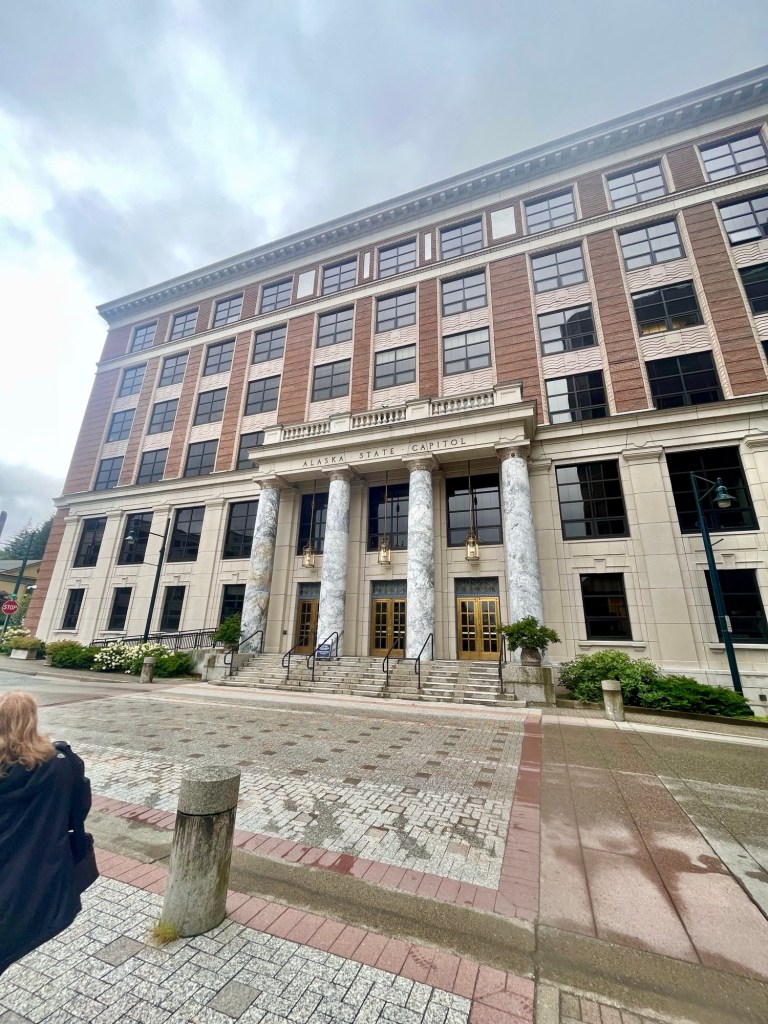
Open for tours, and a short walk from the cruise terminal area, the Alaska State Capitol Building is worth at least walking by if you have the time and if you’re one of the people who wants to visit all the state capitols (like Matt)! Unfortunately, this state capitol building is consistently ranked as one of the worst designs in the country (sad), but at the end of the day, I cannot blame Alaska for keeping it simple and saving that design money.
Alaska State Museum
One of the best museums in Alaska, which is located in a modern—and rare in the case of Juneau—open year-round facility located near downtown. The museum has a multitude of large exhibits, such as those including artifacts relating to Native Alaskan cultures such as the Tlingit, Haida, Tsimshian, and Yup’ik. It also focuses on Alaska’s period of Russian colonization with artifacts such as fur trade items and Russian Orthodox relics. The history discusses the interactions between Russian settlers and Alaska’s Native people throughout this time. There are exhibits surrounding the state’s former and current wildlife, ecosystems around the state and the conservation efforts to preserve them, and the state’s gold rush history and various art exhibits. The museum has lengthened hours in the summer and is jam-packed with Alaska “content” so definitely check it out if you have the time! It is hard to find a better museum in Alaska to explore.
Juneau-Douglas City Museum
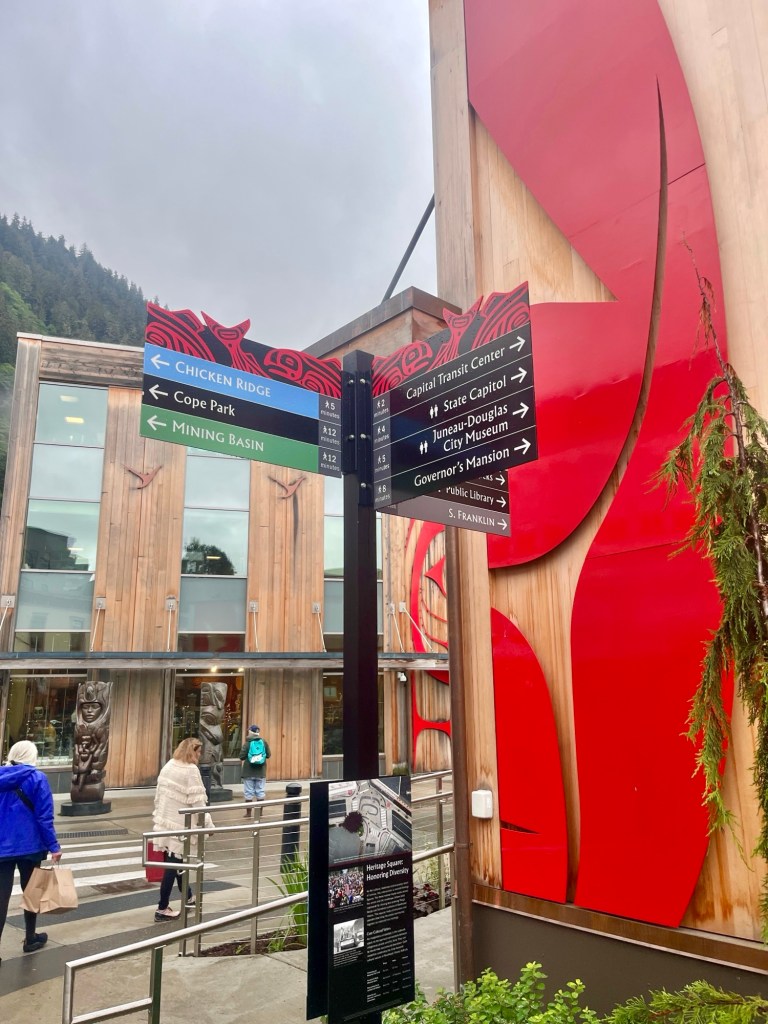
A small museum located right next to the Capitol Building, the Juneau-Douglas City Museum is smaller than the local Alaska State Museum and more focused on Juneau itself. This museum explores more on Juneau’s gold rush history, native Tlingit culture, and contains various historical documents, films, and art exhibits. It’s definitely worth checking out if you’re near the Capitol Building and are a history buff.
St. Nicholas Russian Orthodox Church
This may be slightly surprising at first (until you remember how Alaska used to be owned by Russia and how it is right next to Russia), but Alaska has the highest concentration of Russian orthodox churches in the US. If you’re in the capital area, it’s worth taking a quick stop at St. Nicholas Russian Orthodox Church, which is just a few blocks away. The church is still active today and is open to the public if you want to check out the unique architecture, as well as learn about the history of the church and religion, including the history of native Alaskans converting and still being involved in the church in the modern day.
Shopping and Dining
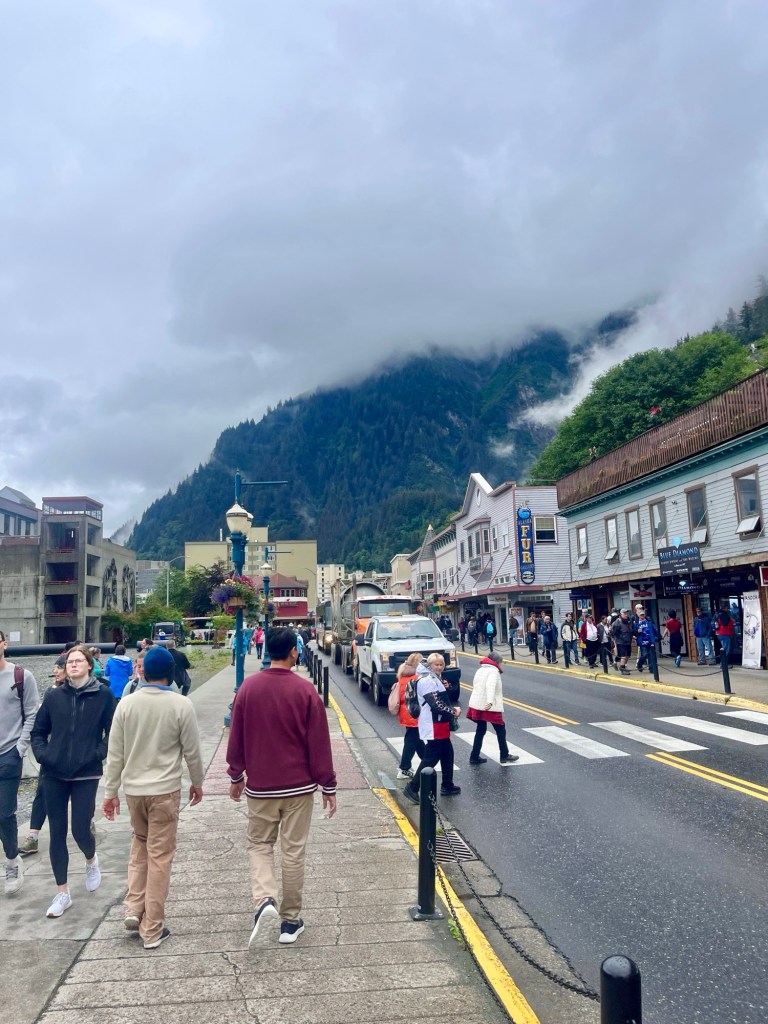
When it comes to shopping, dining, and the more “downtown” feel, South Franklin Street is the place to be in Juneau. A lot of them are more certainly “touristy” shops, but that doesn’t mean they aren’t fun to check out! The street is lined with a large variety of shops, lots of jewelry stores, souvenir shops, as well as more high-end art galleries and crafts.
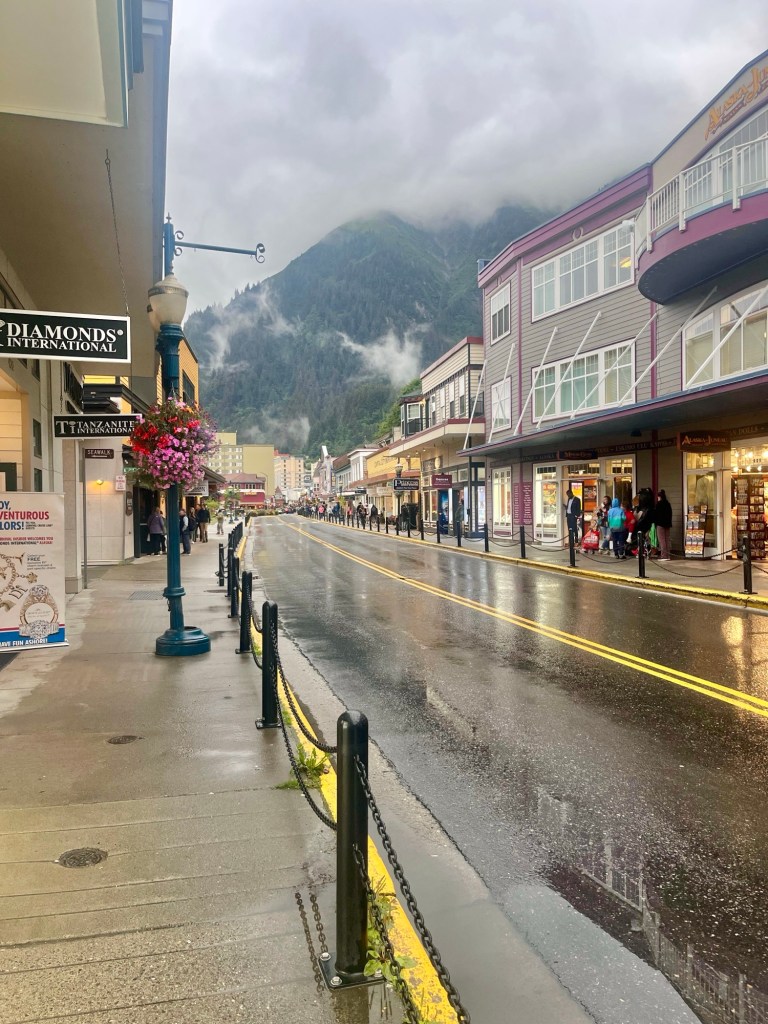
The street is very busy in the summer, with famous Juneau restaurants located on it—such as Tracy’s King Crab Shack or Deckhand Dave’s—or bars like the Red Onion Saloon or the Alaskan Brewing Co. Some shops in the area may close during the winter, but the area still remains moderately lively with locals and any off-season visitors. There are also many local cafes and bakeries for some nice coffee and snacks, the largest being Heritage Coffee Roasting Co.
Additionally, the downtown area and South Franklin Street is known for its early 20th-century buildings, throwing it back to the Gold Rush and mining boom eras that helped build Juneau to where it is today. The downtown area is located close to the cruise ship docks and will be hard to miss for the many that arrive via cruise ship!
Taku Glacier Lodge
While the Taku Glacier Lodge is a little bit off the beaten path, it could be a unique thing to check out! The lodge is a historic wilderness lodge located along the Taku River, that also (aptly named) has some great views of the Taku Glacier across the river. Additionally, you’re actually only able to access the lodge by air or water! Which is very Alaskan and remote, but also from somewhere like Juneau, you can still access it relatively conveniently!
People typically reach the lodge by floatplane, where you can get some great views of fjords, mountains, and glaciers—with views of Juneau Icefield and Taku Glacier, before then landing on Taku River right in front of the lodge itself.
The most common experiences at the lodge focus on the scenic flight to and from, alongside some delicious food once you are there: the classic wild Alaskan salmon bake with various sides and drinks, with the view of Taku Glacier in the background. How can you not love that?
While eating and hanging out at the lodge, you will hear some stories about the history of the area, such as how the lodge was built in the 1920s by pioneer Mary Joyce, how the lodge was once a base for adventurers exploring Alaska’s wilderness, and how Mary Joyce completed a legendary 1,000-mile dogsled journey to Fairbanks in 1936. Respect.
If you’re lucky, you may see some black bears in the area as they’re often spotted near the lodge, with the addition of typical bald eagles and other beautiful wildlife and plants you would see in Alaska.
Of course, it isn’t fun to rush when you are on vacation (especially somewhere like Alaska), but this Taku Glacier Lodge trip is a nice way to take advantage of your time, go on a beautiful scenic flight, try delicious Alaskan food, get a chance to see some wildlife, and learn about a legendary, remote Alaskan place made famous by a legendary woman.
The lodge is usually open seasonally, with most tours available during the summer months whenever weather is good enough for floatplane trips. The tours are run by Wing Airways, check them out here! Also whether you’re visiting or not, it’s still super interesting to learn about the lodge’s history here.
Juneau Icefield Helicopter & Dogsledding Tours
Another common tour that people take (not as common as the whale watching tours, but close) is those that are on Juneau’s nearby glaciers, such as Norris and Herbert Glaciers. Most of these combine scenic helicopter rides with a dogsledding experience.
These tours typically begin with a helicopter ride from Juneau over the Juneau Icefield and surrounding mountains, which as expected, are covered in glaciers. After landing on a glacier (specific one depends on your tour), you will then go dogsledding.
However, it is more than just dog sledding as a lot of the tour involves getting to know the various sled dogs, as well as their mushers! These dogs (and mushers) compete in the famous sled dog races you have likely heard of, such as the Iditarod. Crazy enough (and this still blows our mind), these dogs and their mushers spend a large amount of the summer up on glacier camps near Juneau.
The camps up on the glaciers include areas for the dogs, which often feature kennels or snow trenches where the dogs rest. There are warming tents and shelters for the mushers and support staff, as well as basic facilities for cooking, eating, and living.
The sled dogs that work on the glaciers for summer tours in Juneau often have dual roles. Many of them are racing dogs that participate in famous Alaskan dog sled races like the Iditarod or the Yukon Quest during the winter season. In the summer, they switch to working in tourism to stay active, fit, and continue practicing their skills. This helps keep them well-conditioned for racing, as pulling sleds on the glacier terrain is similar to race conditions.
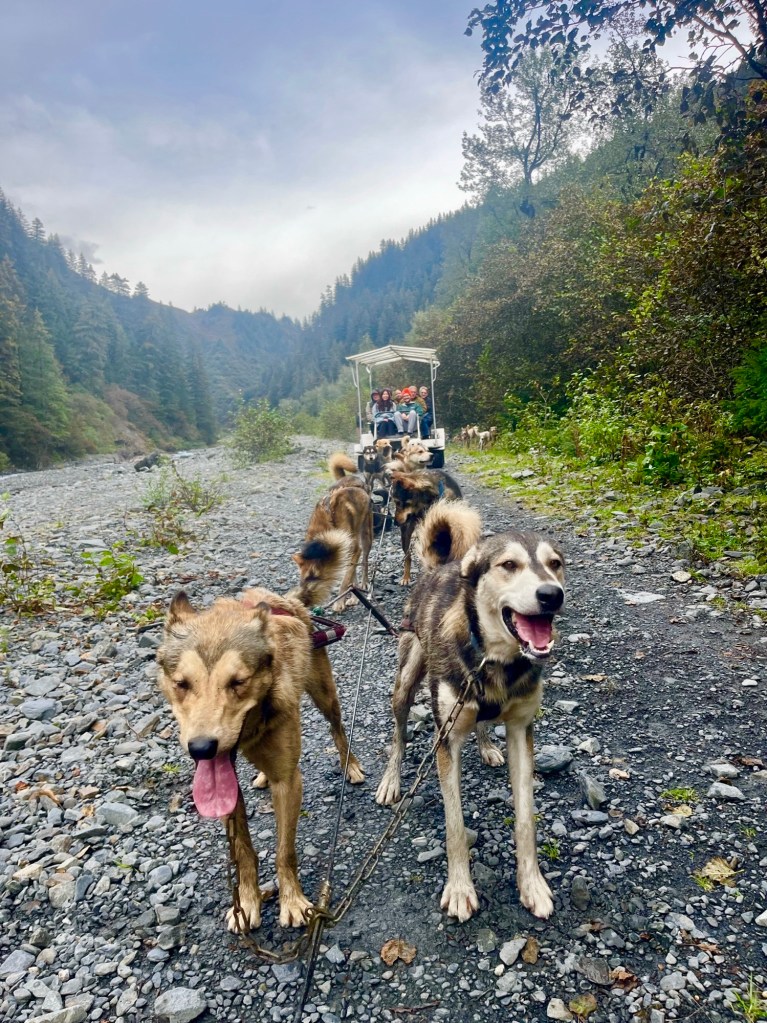
We unfortunately were not able to go on one of these glacier tours ourselves, but we did have a chance to go on a sled dog tour near Seward, Alaska (article coming soonish!) and we can confirm just how excited the dogs were to go out to pull the sled, as well as how passionate the mushers are about the animals. Based on the reviews and info on these outfitters out in Juneau, I’m positive you will feel the same way about these mushers and animals.
Also for most of the tours, you can choose whether you mush your own sled (after a quick lesson), or sit in the sled’s basket to allow a musher to do the work for you. After your dog sled drive, it’s time to head back to the helicopter. Don’t forget to take some pictures with the dogs before taking a helicopter ride back to where your tour began.
Should I book in advance?
Yes (unfortunately), these tours can definitely sell out, especially during the busy summer season where there are tons of cruise ships around, bringing thousands of people into the city each day. More limitations are that the helicopters don’t have a ton of seats, and while not necessarily very common, weather conditions can also lead to cancellations of the tour as they would impact the ability for the helicopter portion to fly.
On top of the traffic in town itself, many cruise ship passengers book these tours in advance, as they are often offered as shore excursions. On days when multiple ships are in port, demand can be very high.
So try your best to book this tour as early as possible if you are interested!
Will I see wildlife?
Your highest chance of seeing wildlife during the tour is during the helicopter ride, where you can keep an eye out for mountain goats, bald eagles, and black bears. Crazily enough, you are even able to see humpback whales (and maybe even orcas if you’re really lucky) from the helicopter through any part of the helicopter trip while you’re over the water.
How much is it?
Unfortunately as you would expect, this is not necessarily the cheapest tour, even by Alaska standards. As of 2024, the standard tour that includes the dog-sledding experience and the round-trip helicopter ride costs $599 per person. There are also add-ons to the trip as well, as far as additional glacier landings that will raise the price. But for many (including me), that don’t live with access to beautiful glaciers, wildlife, and dog-sledding, that makes this a once-in-a-lifetime experience and makes the price all worth it.
Alaska Brewing Company
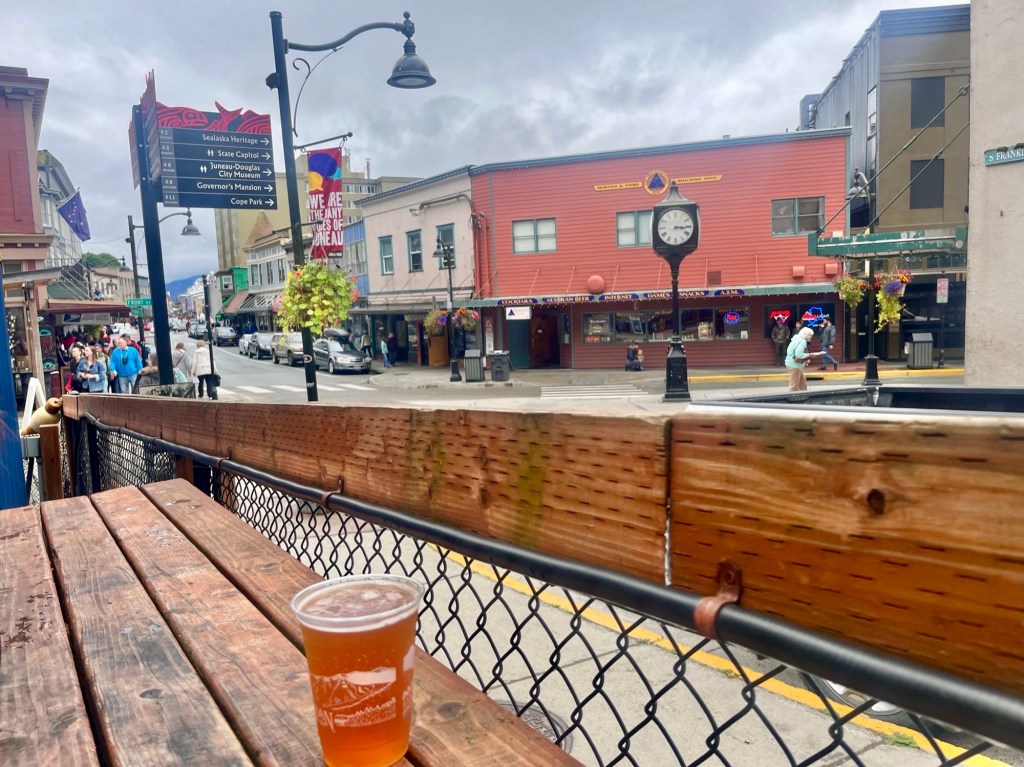
Alaskan Brewing Company is a brewery founded in Juneau back in 1986. It surprised me to see this stat, but in recent years, it has even been in the Top 20 craft breweries by sales volume in the whole United States. Shocked to see an Alaskan brewery (especially outside of Anchorage) that’s that far up there!
There are a few different locations for the Alaskan Brewing Company around town. Two of the locations are seasonal, only open in the summer season from May to September, and one of the locations is open year-round.
Alaskan Brewing Depot
Located downtown, the depot pretty much has all Alaskan Brewing products except for the beer itself. I would probably compare it to a typical giftshop you may see near a cruise terminal or a tourist area, with various clothing, souvenirs, and more “barware” items relating to the Alaskan Brewing brand. A great place if you’re looking for some souvenirs, or especially if you love the beer after trying it at one of the other locations and want some merch! Also, the free shuttle transportation to the “main” Alaskan Brewing location leaves from here as well.
Alaskan Brewing Public House
A better place if you want some beer! This place is also located in the cruise ship terminal area, actually right next to the Alaskan Brewing Depot above. They serve some great food, as well as some Alaskan Brewing beer and cocktails! It’s located in a great spot right by the cruise ship terminal and downtown. We specifically loved their Icy Bay and Husky IPAs and the awesome designs on all of their beer cans, including stuff like the Northern Lights, polar bears, and wolves.
Alaskan Brewing Tasting Room/Brewery
Last but definitely not least is the main brewery itself. The only Alaskan Brewing location open year-round, it is located around 6 miles and around a 10 minute drive from the cruise terminal. Obviously, that can be a bit tough to get to from the cruise terminal for those without a car, but it’s super convenient that they offer a free shuttle, which you can sign up for (and take) from the Alaskan Brewing Depot.
At the tasting room, you can taste test beers not available at the other locations (or even in stores) as well! It also feels like more of a true brewery, with the larger tables, open air, and even food trucks around, compared to the downtown public house location, that feels like more of a smaller bar. This location sells beer to take home, in the typical crowlers, growlers, 6-packs and even kegs. If you have the time and like beer, give it a visit, especially with the free transport!
Where to Next?
After a few days of wandering Juneau, we are hopping on the quickest flight of our life (literally 15 minutes!) to the small town of Gustavus to visit Glacier Bay National Park. Flying from Juneau is the only way to reach Glacier Bay (other than a cruise), which is a huge reason why we were visiting Juneau.
Thanks for reading my little blog! 🙂 Have you been to Juneau or planning a trip or cruise there? Send me your thoughts about what you loved the most or are most excited about! If you have any questions, feel free to leave a comment.
Pin my Juneau itinerary for later!

 mir on mountains
share your thoughts!